Tuesday, May 31, 2011

Strangers on a train...pt. 3


(Part 1 and Part 2).

Regular readers of this blog know that trains are my preferred mode of travel in China. I like trains because I can see something of the country, because I can get up and move around, read comfortably, use a toilet when I need to.

But mostly, because of the stories I get out of every ride.

Submitted as an example: the trip from Kaili to Kunming.

Richard and I had been stymied in our attempts to take the train from Nanjing to Guiyang and from Guiyang to Kaili. We were determined to at least take the train to Kunming. For that, we were told, we would have to go back to Guiyang -- though Kaili is on the rail line from Guiyang to Kunming and actually closer to Kunming than Guiyang, sleepers were always sold out by the time the train reached Kaili.

Except this once.

The lovely folks at the Kaili China Tourism Office, who had been among those telling us that getting sleepers from Kaili was impossible, had somehow managed to secure two berths for us, so we wouldn't have to double back to Guiyang. Nothing against Guiyang, but, you know, not the most interesting place I've ever visited.

We got to the Kaili train station, and understood why everyone had told us, it was "a little chaotic." The Kaili station is a pretty typical, old-fashioned small town station. You wait for the trains on the upper floor, which was standing room only:


EXCEPT right up at the front of the line, which was a posted "No Smoking" area, and therefore undesirable.

The train arrived. We made our way to our assigned car and presented our tickets to the conductor, a young, pretty woman (most of the conductors are young, pretty women. I am reasonably sure that this is a factor in their hiring).

Her brow furrowed. "Xiao wenti," she muttered. "Buhao yisi..."

There's a little problem. She's so embarrassed.

We have a pretty good idea where this is going...

No sleeper car. There would be berths in a few hours, so we'd have a place to sleep. "Not a problem," I said. "Just give us some place to leave our luggage, we'll go to the dining car and drink beer for a few hours."

This apparently would not do. The conductor asked if we would mine splitting up and staying in separate compartments—we could change to the same one later on the trip.

Fine by me.

I was ahead of Richard in the corridor that runs along the sleeping car, so I said I'd take the further compartment.

Walking in, my first thought was, "Boy, did I make a mistake."

My compartment mates: 3 middle-aged Chinese men.

Now, I have nothing against middle-aged Chinese men (I am pretty much in the "middle-aged" demographic myself) except for one thing, in this context: they snore. I don't know whether it's because so many of them smoke, but count on it—three middle-aged guys in a compartment, odds are overwhelming that at least one of them, and more likely two, will snore. Loudly (I have a convenient Snoring Magnitude Rating system, in which two Category 3 snorers are equivalent to one Category 5 snorer, and so on).

Well, I don't take trains in China for the good night's sleep. I smiled, shoved my bag under the lower bunk, put on my train slippers and tried to look inconspicuous.

That wasn't gonna happen.

This was a very chatty group, especially the fellow sitting across from me, a government official from Hunan. I immediately got hit with the questions: how long had I been in China, where did I learn to speak Chinese, what places had I visited, what did I think about China, etc. etc. etc. Another man joined us, a young guy with shoulder-length hair and a John Lennon T-shirt, from Wenzhou. With his accent, I had a hard time understanding him, which was too bad because he was very interested in talking to me.

The government official had traveled to the United States—either during the time of swine flu or in some capacity related to swine flu (#ChineseFail on my part). He'd been to Boston, to Washington D.C., to San Francisco, even to the Grand Canyon. Had loved the experience! And he'd learned a lot, particularly that, in his estimation, "America is much more developed and wealthy than China. It will take China thirty years to catch up!"

"Thirty years?" the young guy from Wenzhou said with a snort. "More like three hundred years! And do you know why? Because Chinese people have no freedom, that's why! Take your President Bush..."

"Heh," I said. "Yeah. I don't like him."

John Lennon T-shirt wagged his finger. "You see? You are allowed to say this. We can't say these kinds of things about our leaders. You have elections, we don't. That's why China can't catch up to America."

You'd think there would be a lot of argument about this, or fear, or something, but no. Some chuckles, some nods. And then a discussion about my iPhone: which generation is that, third or fourth? How much does it cost in America? That cheap, really? (I tried to explain that the low price for the device came with a commitment to a lengthy contract but am not sure that I managed to get my point across)

I think about 20 minutes had passed before Richard poked his head in the compartment. I gave him the recap: "Official thinks China will need thirty years to modernize, John Lennon T-shirt guy from Wenzhou thinks it will never happen because Chinese people have no freedom. And iPhones are expensive in China." He sat.

A few minutes later, the same conductor who had looked at our tickets in the first place came by. Richard turned to me: "She totally gave me the third degree just now." On certain train routes, conductors will swap your paper tickets for plastic ones (and then back again at the end of the ride), and along with that, ask for your identification and if you're a foreigner, your passport. Her interaction with Richard had gone far beyond that: she asked all kinds of questions, about how long he'd been in China, where he was traveling and why.

Now she leaned against the doorway of our compartment. She saw my hand-made Chinese notebook and asked if she could look at it (it has all kinds of vintage images of Chinese leaders taken from old Newsweeks). Where had I bought that? And my postcards, from Guizhou, could she see them? She examined each image (I hadn't filled them out yet). We decided she was not so much about the third degree as she was curious. And chatty. She was from Kunming and had a lot of ideas about the best restaurants there (she wrote them down in my notebook, with my pen, which she also thoroughly examined).

This was a happy train, overall. Even the surly dining car attendant was giggling when I returned there after hours to buy a bottle of water—there she was, giving one of the train workers, a big guy with a big shaved head, a scalp massage, and she waved in greeting along with the others, wished me a good night when I left. Maybe it's that Guizhou vibe I mentioned, that just passing through is enough to make people weirdly friendly.

While Richard dealt with the world's friendliest, most adorable attack toddler in his compartment (he was fascinated by Richard's bag and glasses), I settled down for the inevitable night of snoring.

Sure enough. The quietest man in the compartment, the guy on the upper bunk who during our conversations had mostly listened, smiled and nodded.

I'd put him at Category 4.

Early the next morning, as we approached Kunming, John Lennon T-shirt came by. "How did you sleep?" he asked me.

"Hai keyi," I replied. Okay/so-so.

A few minutes later, he returned, to give me an energy drink and a pastry.

Thursday, May 19, 2011

Gear Review! (second in an occasional series)

(The PR-5, Skytrain and Tilley, on the road...oh, and my PJs)

I have one more post that I want to put up about my recent trip, another of my adventures on Chinese trains (and if anyone wonders why I love to take trains, in spite of some hassles, it's because I swear, I get a story out of every ride). But first, it's time for...GEAR REVIEW!

Some of you who know me, know that I'm slightly obsessive on the subject of luggage and bags. Okay, maybe more than "slightly." It's just, with all the travel I've done in the last few years and all the walking I do normally, I'm dealing with bags all the time, and they have a big impact on my life. Trust me, you do not want to be dragging an awkward, cheaply made bag on and off Chinese trains and through train stations.

I came to the conclusion that I wanted bags that were functional, sturdy and easy to schlep. For all of those reasons, I went with Red Oxx. I wrote about my experiences with Red Oxx in my earlier gear review. Since then I've added a few new bags (I don't have a problem, I can stop any time) and have had plenty more experience with the old ones.

(Red Oxx Skytrain)
My workhorse remains the Skytrain. It has been with me on many trips at this point and I can't see a sign of wear. I know that a lot of people are partial to wheeled luggage, and I understand why, but a soft-sided bag like this is easier to cram into tight spaces (overhead compartments, under train seats), and much easier to maneuver when trying to stow over your head, get on and off of trains and planes and up and down staircases. Just don't overload it with heavy stuff, because as sturdy as this bag is, it will support whatever you manage to cram in it.

For my second bag, I got the PR-5. This is another maximum-sized carryon, and it holds a ton of stuff. I find the outside end pockets particularly useful for stowing a pair of shoes (in one) and whatever I want quick access to (in the other). This series of bags also has a passthrough pocket, so if you are using any wheeled luggage or luggage rack, it will slide over the handle. It's actually easy to carry for a shoulder bag; the Claw shoulder strap distributes the weight surprisingly well.

(The PR-5)

I took this larger duffle because of the extreme range of climate I covered in this trip and also the possibility that I'd have to dress nicely on a few occasions. It's just a great bag. But for shorter trips when you don't need that kind of capacity, I love my PR-4. This smaller duffle fits perfectly under airplane seats, and again, the handy end pocket is a great place to put items you want to get at easily during your flight.

(the PR-4)

As mentioned in my earlier review, Red Oxx products are made in the USA and guaranteed for life. Yes, they cost more than a lot of luggage, but you will never have to buy a replacement, and you'll never find yourself dealing with a broken zipper at some inconvenient moment on the road. Their bags come in twelve nifty colors, so you can express yourself too!

Least you think all of my luggage love goes to Red Oxx, let me plug a couple of other useful bags.

First, Patagonia's Travel Tote. I have an older version of this bag that has seen many trips and much hard use and was finally showing signs of wear (for a lightweight, packable bag, these things are pretty damned sturdy). So I upgraded to their slightly revamped current model. The major improvement is longer straps so you can sling the bag over your shoulder when you don't want to use it as a backpack. This is an extremely practical, versatile bag that I'd recommend to any frequent traveler—I honestly can't imagine a more useful alternative for a travel utility bag to this.

(Patagonia Travel Tote, with backpack straps stowed)

I'm not a "purse" person nor am I into briefcases, but there are occasions when I need something to fulfill those functions—going to a meeting, a conference, what have you. For this, I chose a custom Timbuk2 Messenger bag. Like Red Oxx, Timbuk2 products are made in the US (in San Francisco), and come backed with a beefy warranty. Plus, they're cool-looking. I customized mine and had a lot of fun choosing the fabrics and features. The small Messenger is just wide enough to stuff an extra sweater and a larger digital camera (with a standard lens) — it's a tight fit, and not ideal (in fact, Timbuk2, if you're reading this, a little bit of extra width on the Small Messenger would be awesome—the Medium is just too big), but I did it. If the trip had been more about photography, I would have considered taking my Red Oxx Gator instead—its width and padded bottom make it perfect for that (as well as fitting under an airline seat). But those same qualities make it less than ideal for carrying around town to meetings or for use as a "purse/briefcase," so I went with the Timbuk2.

(Timbuk2 small messenger bag)
Two more items that have become permanent parts of my travel repertoire: a Tilley hat and an 11" Mac Air.

Tilley's are made in Canada, high-quality, functional and even look kinda cool. Plus, they come with a great warrantee and a secret pocket! I have the Cotton Airflo. Yeah, not cheap, I know. But I walk a ton, and I'm not always as good about putting sunscreen on as I should be (it gets in my eyes), and this hat is about as comfortable and practical as they come.

Finally, the Mac Air.

I write, blog and post photos when I travel, so a laptop really is pretty essential. And, yes, I'm a Mac person. I tried using a Linux-based netbook once, and while I'm sure Linux is just swell, I really didn't want to take the time to learn to use it, plus I wanted to use the same system to upload photos and keep my stuff so it was easily transferrable. Plus, Windows in China is asking for trouble, given the proliferation of viruses and spyware. For a few years, I traveled with an old 12' iBook. Kudos to that thing for sturdiness and long-life—it still works! But it's just a brick. You don't think so, at first, but after a month-long trip with constant travel, it starts absorbing the weight of the road, I'm pretty sure.

Then the new Airs came out. Wow. This is the perfect road warrior for Mac people. It uses flash memory instead of a moving hard drive, so it's sturdier. It's incredibly light. Incredibly thin. And it's a lovely piece of machinery that's a pleasure to work on.

Caveats: I got the stripped-down version, straight out of the box. It does not have a ton of memory or RAM. It does not have a CD/DVD drive. You can get models with more memory (but you have to order it that way, they are not easily upgradable) and you can order a compact exterior DVD drive if you want to have one. For me, none of this was an issue—I wanted a laptop designed for travel that I could use for writing and photos, and it does those things wonderfully well. In fact it's so nice to use that, well, I'm using it right now (light! Amazing screen! Great keyboard!).

Another small item you will want to invest in: the Air has two USB ports and one Firewire port. There's no room for anything else. That means, no Ethernet port. But you can buy a little adaptor that plugs into the USB port for your Ethernet needs. Many inexpensive Chinese hotels offer broadband access in their hotel rooms, but it's via Ethernet. I got my adaptor at an Apple store, but Amazon offers them too.

(one more thing: Mac Airs don't like Adobe Flash very much. I downloaded a simple, free program called "Click-To-Flash" — I highly recommend it).

One final item you will want if traveling to China, or to anywhere where you have reason to believe that internet security/accessibility is an issue: a VPN. Even with Witopia's excellent product and great customer service, China's Great Firewall makes internet access a huge pain in the ass at times. But I wouldn't consider traveling to China without one. When the Chinese government decides that Gmail is subversive and tries hacking into it? Yeah, I want a VPN.

Well, I think that's it for this year's long, somewhat tedious and obsessive gear review. Other travelers, please feel free to add your tips and favorites! I'm always ready to feed the obsession!

Monday, May 16, 2011

A Belated "Congratulations!"


And an embarrassing one at that, because how many times does a good friend's first book launch? Probably not more than once! Though given that the book is about three kids who trade a corn-dog for a spaceship and accidentally break the universe! I am not willing to totally rule out the possibility of some sort of time-space anomaly occurring in which the launch happens over and over again in an endless loop, except that would probably mean that I'd forget to make the announcement each time, over and over again, and that would be even more embarrassing....

Where was I?

Many congratulations to Nathan Bransford on the launch of Jacob Wonderbar and the Cosmic Space Kapow, a book for middle-graders that's fun for us above middle-graders too. I've had the pleasure of reading JACOB, and if you like your space adventure with a sprinkle of Douglas Adams and a twist of Roald Dahl (or you think the kids in your life will), then get your hands on a copy, before the universe breaks!

Sunday, May 08, 2011

Guizhou Pt. 4

We went to a number of villages during our stay in Guizhou, but one of the more interesting was Shiqiao, where the speciality is paper-making.

We'd actually stopped first at a cave site some distance away. "This is a good place in the summer," Mr. Ou, our driver, told us. "It stays cool in here."


There were various ramshackle structures made of wood, some holding cloudy water and grayish white fibrous tangles whose composition and potential function I could only guess at. Mr. Ou did his best to explain, but at first I wasn't getting it.

After a while I finally figured out that "shu pi" was not, like, leather something something, but tree bark, and that they were making paper.


After the cave, we made our way to Shiqiao Village. Many of the families here are engaged in paper-making, and each family makes its own. Here are a few photos of the process:


We stopped in at one of the larger operations. I found out later that this is a paper-making cooperative, created to preserve traditional Miao methods, an effort that has made this household the wealthiest in Shiqiao.

They had a storefront of sorts, shelves with stacks of handmade notebooks and sketchbooks and larger sheets of drawing paper, a graying PC and a ledger book on a small desk. Famous artists come here from the big cities to buy their paper, Mr. Ou told us.

"You can try it!" the proprietor, Mr. Wang, urged us, holding out an ink brush. He had sheets of paper laid out on a long table, where other visitors had scrawled their names and countries of origin.

"I have terrible handwriting," I warned. Which is true (I'm left-handed, for one). But I also used to do a lot of art back in elementary and junior high. It was about my best subject.

So, I wrote my name, and for some reason, using the ink brush, I was able to do it neatly, in a sort of grandiose way.

Mr. Wang loved this. So did our female host (I am assuming Mrs. Wang, but I don't actually know for certain). "Draw something!" they urged me.

Well, okay. I drew a cat.

Our hosts seemed to think that this was pretty amazing. I was just glad that I'd managed to draw a recognizable feline.

We went upstairs for lunch. Not a formal restaurant, but an area where guests and tourists could be served. I know that Guizhou is incredibly poor in terms of per capita income, and I'm sure that we didn't see anything close to the real poverty that must exist there. But I have to wonder, a little, because some things about the lifestyle here are pretty amazing. The wooden houses, for example. Basic, yes. But airy, pleasant and in their own way, beautiful.


I was heartened to see that in all the villages we visited, new houses were still constructed in this traditional architectural style—hardly any incursion of white tile disease.

Would I want to be a peasant farmer, working terraced rice paddies in my bare feet, behind a water buffalo? Not so much. And I don't want to overly romanticize a way of living that requires a lot of very hard work and doesn't have a lot of the "mod cons," the connectivity and stimulation, that I myself would not want to do without.

But the incredibly gorgeous landscape, the clean, fresh air, the festivals and celebrations...surely these are worth something on the scale of a good life. When I consider the environmental devastation in so much of China, I wonder if in the long run, the inhabitants of Guizhou will finally benefit from their poor, stunning homeland...

This paper-making household is a regular stop on the slowly developing tourist circuit. There was a group of French people who came in after us for lunch (the French, we were told, are the most numerous Western travelers in Guizhou), about ten of them, with a guide.

(Mr. Ou, our driver, and Mrs. Wang (?), papermaker and one of our hosts)

After a round of homemade wine (yum!) and a few bites of lunch (simple but delicious, one of the best meals I had), the proprietor came upstairs, beaming, carrying a mounted square of blank, handmade paper. "After lunch, you can write your name and draw the cat again?" he asked. "And we can put it on the wall!"

I agreed, a little embarrassed, and told myself I'd better go easy on the rice wine.

Submitted for your approval...my goofy cat:


In return for my efforts, Mr. Wang gave me one of their notebooks. I'm looking at it now, at the beautiful, soft paper made by hand. I'm thinking, maybe I should buy myself an ink-brush, and learn how to draw something other than a cat...

Oregon in June! And San Diego next week!

I'll be doing a few events in Oregon in early June, including the world-famous Powell's Books in Portland on June 7. I'll also be in Ashland and Klamath Falls — more details to come, but here's a link to the wonderful organization who is sponsoring my Ashland leg, the Ashland Mystery Readers Group. Events there are scheduled for June 10th and June 11th.

I'm really excited about this! I have never been to Oregon, and it's past time to remedy this situation.

For those of you in the San Diego area, as mentioned, I'll be at the fabulous Mysterious Galaxy Bookstore's 18th Birthday Bash on Saturday, May 14, along with a whole bunch of authors signing Akashic Book's latest Noir release, San Diego Noir. There are signings going on all day, and cake! Mysterious Galaxy is a fantastic indie bookstore, and those of you in the San Diego who haven't been there are missing out—what better time to visit?

(as a p.s., times, addresses, phone numbers and directions to events can be found at my website, on the calendar)

Thursday, May 05, 2011

Final count...


More on Guizhou in a bit, I promise. But for those who follow my Twitter feed, here is a final tally of the hooker cards!

First, an explanation: the Beijing hotel I stayed at is known as a "business hotel" — a popular choice for visiting businessmen. I really would recommend it, overall. Decent rooms, clean, great location, and overall, quiet.

However, with a "business hotel" apparently come certain expectations of a businessman's needs.

Numerous times a day, I would hear a little scratching noise at the door, and then a slither and a soft "plop" as business cards, shoved through the crack in the door, fell to the floor. Coming back to the room after a time out, sometimes I'd find a half dozen of them on the floor. Photo cards adverting prostitutes.

I decided to save them all and see how many I had at the end of my stay.

The grand total: Sixty, three of which are half-sized. Because paper is expensive? Because they are more discreet? Who can say?

Anyway, if anyone out there is doing a sociological study or art project involving sex work in China, let me know, and the cards are all yours...

Tuesday, April 26, 2011

Guizhou Pt. 3


Everyone agreed that taking the train from Guiyang to Kaili would not be as "convenient" as taking the bus. The train station was "a little chaotic," the desk clerk at the hotel informed us. And besides, the bus left every hour.

The long distance bus station is on the fringes of Guiyang, seemingly an artifact of some master plan where the current city of Guiyang swells far beyond its current boundaries to some new, "modern" ring of villas and suburbs that haven't yet been constructed, that are only a dream on some central planning commission's drawing boards and the occasional aspirational billboard. The bus station has the same swooping curved roof as just about every Chinese airport constructed in the last few years, modeled after the archetypical Beijing Capital Airport Terminal 3 built for the Olympics. Inside, it's the same dull mat white walls, scuffed and smudged, grilled ticketing windows and truncated tubular crowd control fences, the less citified customers cutting lines wherever they can.

A helpful information officer led us over to the appropriate window to get tickets to Kaili. We were told to "mashang zou,"—our bus was leaving soon.

We made our way out the back, to where the buses waited.

Our bus: the most broken-down bus on the entire lot. Soiled doilies on the head rests. Seats that smelled like someone had spilled a bottle of baijiu on them—they reeked of stale alcohol.

Suspension? Shock absorbers? The bus laughed at such bourgeoise notions.


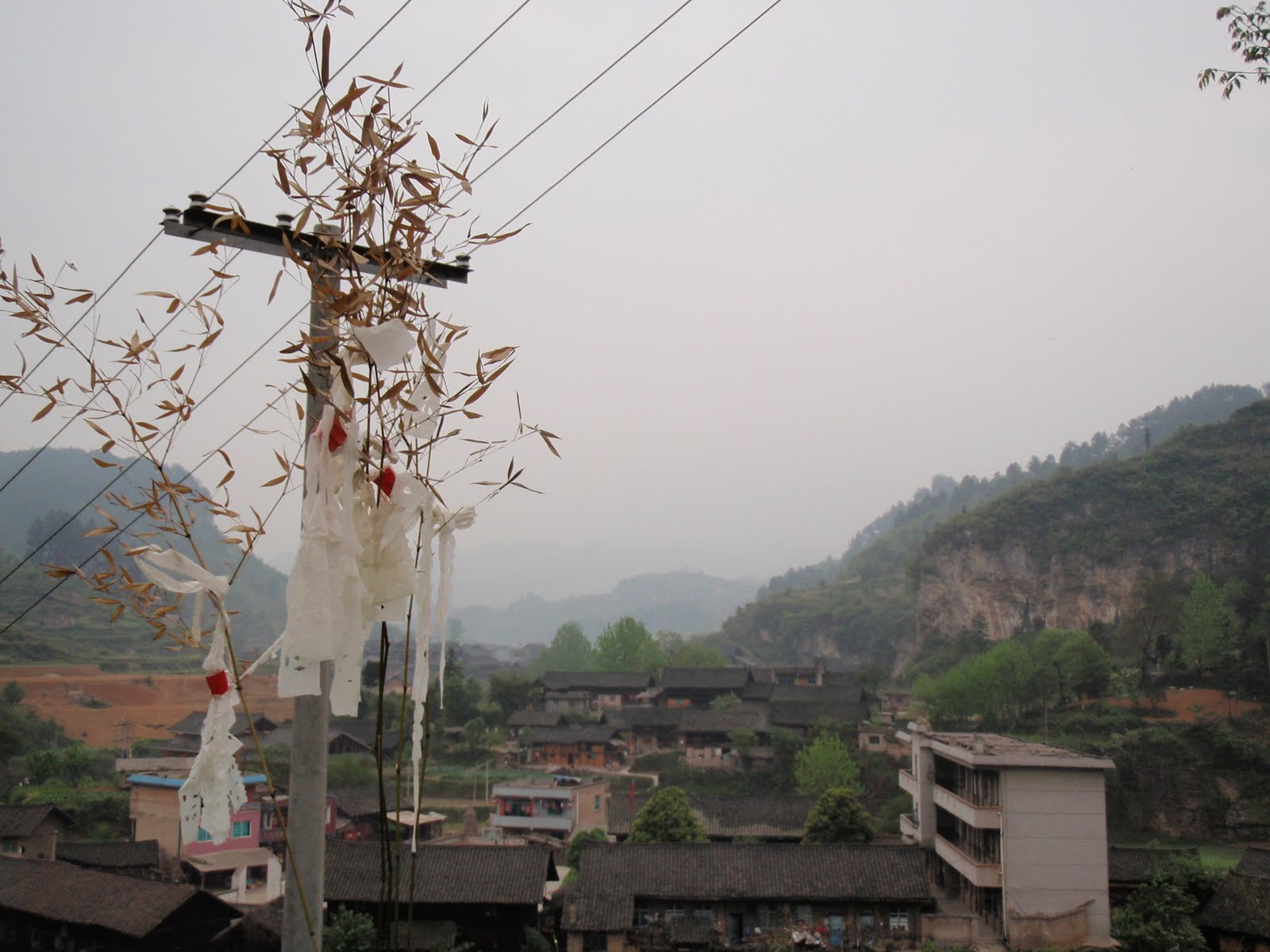
We traveled through a green, increasingly hilly countryside. The most striking thing to me were the graves. There are graves everywhere: grass mounds, mostly, some covered in gray stone, like Celtic cairns. All topped by flags on poles made of twigs: scraps of banners, shredded by wind, all white, with red bands. Later, we would see graves in the most unlikely places. Once, on the outskirts of Kaili, where autoshops and junkyards had been carved into the hills (the city of Kaili seems to have been created by blasting into granite mountains), there was a tiny copse that had somehow been left, surrounded by piles of auto parts, fenders and doors and stacks of tires, and there were graves there, too many, crammed into that tiny space. And I wondered, where were there families whose loved ones were buried here? Did they come to pay their respects, still? Did they sit on a pile of hubcaps to do so?


Some three to four hours later, we arrived in Kaili.

Kaili is the capital of the Miao/Dong minorities Autonomous Region in Guizhou, described by Lonely Planet as a jumping off point to visit villages without any great interest of its own. I liked Kaili. I couldn't tell you why, exactly; on the surface it looked like any other third-tier Chinese city. But there's something charming about it. Maybe the size: at about 500,000 people, Kaili is a small town for a Chinese city. Most likely, the people. Did I mention that, even though I hate making these kinds of gross generalizations, as a group, Guizhou people seem unusually friendly? I don't know how much of this was because we were foreigners visiting a place that didn't see all that many (we hardly spotted any Westerners our entire time there), or how much was due to the culture. According to the "Tourism Attractions of Kaili" book in my hotel room, around Kaili, "Every day is a festival. Every third day is a major festival." I kind of believe it.

For example: Richard, my traveling companion, had a minor injury that needed attention, and we decided to stop in at the Kaili First People's Hospital to see what could be done. It was close to 5 PM. The reception nurse walked us to the doctor's office. The doctor, who seemed impossibly young, let me hang out in the exam room, and later, took us upstairs to see his boss, who was just getting ready to leave for the day and had his eight year old son in the office. The son and I entertained each other (we determined that he wanted to be a jet pilot when he grew up, among other things), while the father put his white coat back on and attended to my friend. Afterwards, problem treated, he invited us both to dinner.

We declined. You know, stuff like that is awkward. Did he mean it? He seemed to.

So we had our own dinner to figure out. After a lot of fruitless wandering looking for a recommended night market, we finally hopped in a cab and asked the driver if he had any suggestions for dinner. He immediately brightened. "Have you been to the best Miao restaurant? You should try that!"

A short drive and we were there. To the left was what appeared to be banquet rooms for large parties: Miao women in traditional dress lined up at the entrance, along with Miao men holding the huge pipes used to play the old music. We went into the main restaurant. This was the only place in Kaili that we saw other Westerners, a Canadian (?) family with a tour guide. Even so, it seemed like it was still a big deal for foreigners to come in to dine. We attracted a lot of attention.

For example: after ordering (the recommended local beer, an amazing Miao tofu dish, some scallion pancakes, a superb cabbage-based soup), a man in his thirties approached our table and started chatting with us, a younger man trailing behind him.

He was a minor government official in some educational capacity, and at first we thought we were being hustled to take questionable English teaching positions (this happens a lot). The younger man was his fuwuyuan, specifically his driver. I offered them some beer—it seemed like the thing to do.

"I'm being presumptuous," he kept saying, "because I have been drinking. But I saw you and wanted to talk with you."

They sat for a while. He talked and asked the usual questions: Where were we from, how long had we been in China? Refused our offers of food but drank more beer (we kept them coming). Our waitress thought that he was pretty funny — "He likes to chui niu," she said a couple of times, a polite version of a phrase that means to blow your own horn. I didn't think he was really doing that, but it was hard to figure out just what it was that he did want.

Which turned out to be, to buy our dinner, which we found out after he finally did say goodbye.

The next day, we went out to visit some "minority" villages. We'd decided to splurge and hire a driver—it seemed the most effective use of our limited time (a note for travelers: Lonely Planet highly recommends the Kaili China Tourism Office, and they are right. Super-helpful folks). The driver, Mr. Ou, was not supposed to be a guide per se, just a driver, but for us, he was also the perfect guide, explaining just enough without going into some memorized spiel. Throughout the day, as we were driving and would see some spectacular spot, he'd say, "Do you want to stop and walk a while?" (we hired him again for Day #2) In many ways that was the best part of the experience—just walking through this spectacular scenery (I hope the photo essay below gives some sense of what it was like).

The biggest tourist attraction in the area is Xijiang—the Miao "Thousand Household Village." And there are some definite signs of tourist development there:


(ATMs, post office, cell phone cards and services readily available as well)

Still, I'd recommend Xijiang for a visit. The architecture is truly lovely (the top photo in the photo essay below is Xijiang), and I personally am a sucker for the Miao music. And the rice wine...


One last note...

As we left the village, riding in a convenient electric shuttle (yes, this is a fully developed tourism site), an older woman dressed in cargo pants and a baseball cap started chatting to Ou. "Are you their guide?" she asked. "Where are they from?"

"They're Americans," he replied, "and they speak Chinese."

She turned to us. Her accent was a giveaway, but we asked anyway. She was a Beijinger. "I'm traveling by car with my older brother," she explained. "We've been to Xi'an, to Kunming, to Guilin..." She grinned and gave a little shrug. "I'm retired, so why not?"

"That sounds like a lot of fun," I said.

"Where are you going next?" she asked. "Why don't you come with us, back to Beijing? We'll stop and visit Hunan. It's just the two of us; we have plenty of room!"

She seemed to mean it, too. Beijingers are also friendly folks, in my experience.

We'd already booked tickets to Kunming, and besides, it's such an awkward thing, to consider accepting a stranger's hospitality. But it was another one of those moments that made me glad I'd decided to take this trip.

Saturday, April 23, 2011

Guizhou Pt. 2

I have a lot to say about Guizhou, and normally I would write a post and intersperse it with photos. But thanks to the Great Firewall, it took me so damn long to upload all these photos that I don't have time to actually write anything before returning to Beijing, and I wanted to share with you how stunningly gorgeous this place is.

So, presented without captions, here's a little photo essay for you. Keep in mind that the photos don't do the real place justice. You'll have to imagine the clean, crisp air that smells like pine and woodsmoke and flowers, for one...and the taste of the local rice wine!

(Click to enlarge)


Friday, April 22, 2011

Guizhou Pt. 1

I knew very little about Guizhou before my friend Richard suggested that we visit it this trip. It's one of the poorest provinces in China, west of Guanxi and east of Yunnan, with a high percentage of "national minorities" (the officially favored term) — Miao and Dong in particular. We had also heard that it is spectacularly beautiful and rarely visited by tourists. Good enough reason to check it out.

You'd think it would be easy to catch a train from Guilin to the capital, Guiyang, but not so much. Apparently a new high-speed rail line is in the works, but for now, flying was the easiest option. We arrived in the evening at your basic (decent) Chinese airport, most notable for its extremely orderly taxi line.

From the cab window, Guiyang looks like any other second or third tier Chinese provincial city: lots of strange gray and tan high-rises with fogged mirror glass, shorter, white-tile fronted buildings with blackened grout, apartment blocks with sagging, rusting balconies. And, even in one of China's poorest provinces, a luxury mall advertising Gucci, with promises of Armani to come.


I made reservations at a hotel through a China travel site that I frequently use. There weren't a lot of recommends for Guiyang, but 4 stars at the price of around $30 seemed pretty good.

Of course, there are catches to everything. In this case, the cab driver brought us to the address, which looked like another slightly seedy mall/high-rise from the outside. The sign for the hotel was posted in big plastic letters across the front of the building about five floors up. But there was no obvious entrance. We stumbled around with our excess of luggage, going downstairs to a greasy-smelling food-court, then upstairs on an escalator to the third floor, which at first looked promising but turned out to be a cinema multiplex.

Luckily the locals are very friendly. I'll be saying this a lot over the next few posts: the people in Guizhou are about the friendliest, most helpful people you'd ever want to meet. I hate making those kinds of generalizations, which by and large I think are pretty meaningless, but that's sure how it seemed.

One of said helpful folks pointed us in the right direction and walked us halfway around the corner to be sure we found the entrance. It was about the least likely looking hotel entrance you can imagine, especially for a "four star" hotel (someone was being awfully generous with that star rating).

For example, when we walked around the corner, this building below was what was on our left:


Then, to our right, the actual entrance, with the red lanterns:


The oddest part was, you walk into a lobby that's for the entire building and which has no direct connection to any hotel at all. Then into a narrow narrow vestibule that looks like it should be in the basement of some fairly sleazy, well, I'm not sure what. Faded, cigarette-burned and warped linoleum, torn plastic ads on the three elevators there. And of the three elevators, only one of them went to the hotel, which started on the 25th floor, which instead of being the 25th floor, was labeled "G" (for a Japanese hotel group).

Once you reach "G," which takes forever, with only one elevator that goes up there, you are greeted by an actual hotel-type lobby which really is pretty cute. And then you have to get in another elevator to go up to the next four floors, which make up the hotel.

After all this, we needed a drink, STAT. Thankfully there is a bar in the building. But first you have to ride the G elevator down to the first floor (yes, only one elevator goes to the first floor), get off, and ride a different elevator up to the fifth floor, where the bar is.

The first thing I did was memorize the fire escape stairs. Because you would not want to be waiting for that elevator in case of an emergency.

As for the bar, it was small, smoke-filled and featured fish tanks.

Wednesday, April 20, 2011

Two Yangshuo views...

I tried to upload a few more but this looks like what I can get for now...


Just one thing...

Really hope to be able to post some photos and an account of the time in Guizhou tomorrow...but for now...I leave you with this...

Tuesday, April 19, 2011

Yangshuo

Well, I'd planned on posting a series of photos showing off Yangshuo's incredible beauty—and I gotta say, I loved it there the second time as much as I did the first—but the Great Firewall right now is frustrating all my attempts to do this. And I have some lovely photos too! Otherwise, I was going to talk a little about how even though it's a very touristy place, it's still awesome and lovely, and how the influx of foreigners has led to some interesting cultural fusions, and how much I love biking around in the other-worldy hills, breathing the clean air, every now and again seeing something like a pretty young woman working the fields wearing a T-shirt that says "Awesome Cutie Honey" and wondering about her life—stuff like that. But basically I didn't have much to say because I was too busy just taking it all in and going, dang, this is one of the most beautiful places on the planet, so here are some photos. Except I can't post them.

So, here are a few photos from my first trip to Yangshuo in Nov./Dec. 2009. Here too.

Right now I'm traveling in Guizhou, which has been super-interesting. I hope to write up something about the experience thus far tomorrow. Only don't count on any photos...

Saturday, April 16, 2011

To market!


I'd heard that one central agricultural market supplies the majority of produce for the entire city of Beijing—according to this Global Times article, 70 % of vegetables and 80% of fruit (the photo above is an example of a typical city fruit vendor).

I'd also heard that the majority of Chinese agriculture is still conducted by individual small farmers, which is both heartening and scary—the latter due to the difficulty of enforcing regulations concerning pesticide and antibiotic use, and, you know, adding melamine and stuff.

These two things seemed hard to reconcile.

I decided to make a field-trip to said market: Xinfadi in Fengtai, South Beijing.

The photo above was taken at the entrance to the market, a huge dirt lot surrounded by walls that spreads out over a couple of city blocks.

The trucks line up in rings, sorted by the type of produce they sell. Apartment blocks of south Beijing in background. As mentioned in the GT article linked above, the market is due to move out to the 6th Ring Road in a year or so.

Scenes from around the market. As far as I can determine, the farmers bring their own produce in by truck. According to one article I read, the market is open 24 hours a day, 7 days a week, 365 days a year, with the busiest time being from 4 to 6 AM.


Random foreigners apparently are not a common site at Xinfadi. You'd think the occasional Western chef would make his way out here to buy for a restaurant, but we didn't encounter any. Maybe they come at the magical 4 AM to 6 AM hour, if they come at all...