Thursday, March 12, 2009

Strangers on a train...

Two days on a train is a long time.

Maybe if we were talking the Orient Express here, it would be more of a vacation, like a cruise, but most Chinese trains are decidedly not the Orient Express (is the Orient Express even the Orient Express these days?). Even if you take soft sleeper.

I am past the point in life where I need to take hard sleepers to save money and/or prove a point. Not like thirty years ago, when we were students trying to save every kuai we could. More to the point, the Chinese authorities back then didn't want us saving money by taking hard sleepers (and not paying steep "foreign friends' rates" on just about everything else), and they wanted to keep us as segregated from ordinary Chinese as possible, which was all the more reason to fight for them at every opportunity.

Of course, sometimes we were grateful for the privileges granted "foreign friends." Like the time our Chongqing minder had his final act of revenge.

I don't want to smear the guy inaccurately, so I'll have to double-check my old notes and letters home, but I'm pretty sure he was the person responsible for handling our train tickets from Wuhan to Kunming - a long trip, more than thirty hours at that time, as I recall. And he booked us in hard seats. At the height of Spring Festival. And didn't tell us.

Hard seats are the only option for many Chinese, and just because you've purchased a "hard seat" ticket doesn't guarantee you anything like a seat. It means you can get on the train, cram yourself in somewhere, on a table, in the aisle, in the corridor outside the toilet, with everyone's bundles and baskets and TV sets and earthly goods, and make do. For over thirty hours.

We crammed ourselves in two actual seats, amazingly enough, with space on the little table to rest our things, and told ourselves okay, thirty hours plus of this. At least we saved some money. Meanwhile the car continued to fill with passengers and their baggage, to the point I wondered how I would ever get out of this seat to, you know, use the toilet. Which on a ride this long I would certainly need to do.

The train crew saw us. They were horrified. This. Would. Not. Do.

So they took us to their xiuxi car - the rest car for train workers. A lovely, nearly empty hard sleeper.

We shared the car with the train workers when they took their breaks and with another passenger, a pretty young woman who'd been traveling alone and had gotten a top bunk - the train personnel were afraid that she would be "bothered" there, or maybe she already had been, so they brought her to our little sanctuary as well.

Paul at the time wore a baseball cap sent to him by a friend in America - after months of hearing us complain about Chinese bureaucracy, she'd found a cap with "KAFKA" embroidered on it. Baseball caps were a novelty in China at the time, and all of the workers and the young woman, wanted to try it on. I have slides of them, smiling, wearing the Kafka hat.

So. Anyway. Nowadays, soft sleepers are fine by me.


A soft sleeper is a closed compartment with four beds for four passengers (a hard sleeper, by contrast, is an open car with three pallets facing three pallets in an open compartment). Your experience on a soft sleeper, therefore, depends largely on who you share your compartment with. Particularly when the trip is two days long.

My cabin-mates: an older Chinese couple who looked to be from the countryside. Their relatives, presumably, had helped them load their things onto the train. The woman was short and round, heavy, almost appearing swollen, skin brown as a nut in a way that did not look to be from the sun. She had some kind of chronic illness; one had was partially paralyzed and she had difficulty sitting up and getting to her feet, something serious having to do with her brain, her husband explained to me. "But she can still walk." That was as much as I understood of his explanation. He spoke a heavy dialect, Sichuan, I gathered, as that was their original home, though they'd lived in Turpan for the last twenty years. Her dialect was even thicker; I could hardly understand a word she said. I don't know whether this was due in part to her illness, whatever it was. She seemed a little odd. Her husband spent a lot of time out in aisle, gazing out the window, and sometimes she would become agitated and call for him in a hoarse voice. He either couldn't always hear her or had learned to ignore her when it was convenient. By contrast he was thin, wiry and seemingly fit, except for an intermittent cough, so severe it sent him into near-convulsions. He didn't smoke, so maybe he was sick. His wife had it too.

Oh, great, I thought.

The fourth person in our compartment I dubbed, "Slightly Obsessive/Compulsive Guy" - the first thing he did when he entered the compartment was to straighten up the communal table so that the newspaper lined up perfectly with the little aluminum tray. He was my age, and kind of a health nut, one of the rare Chinese men who doesn't smoke and doesn't approve of smoking. He also had a lot of ideas about diet, and about healthy psychological attitudes (he found me admirable for some reason that I've forgotten now). He spoke in Sichuan dialect too but was able to reply to me in Mandarin and translate my Putonghua into dialect so that the old woman understood what I was saying as well. She seemed unable to grasp why it was that I could speak some Chinese but not understand her, so this was helpful.

The first morning I woke up to the loud, cheesy guangbo (broadcast) telling us that it was, in fact, morning. Yeah, I needed to know that. Outside, steep peaks and snow. Gravestones interspersed in the fields with ragged paper flowers and lantern tributes, facing the tracks.

I was restless, that first day. I finished one novel and read another. And realized that I was out of books, and my Treo was nearly out of juice. The Treo has my Chinese dictionary (I do have a paper backup), my ability to connect to the internet on the road and all kinds of things I could potentially read on it. None of the electrical outlets in the soft sleeper car worked, and it was the only soft sleeper on the train. Hard sleeper cars, at least on this train, don't have any outlets. The train worker tried to explain the situation to me, why the plugs didn't work; there seemed to be some larger reason, but I couldn't understand. Later, she took my Treo and the charger to the xiuxii cabin, where there was a working outlet. She seemed happy to be there, doing this job, a woman around thirty with big, striking features accentuated by the makeup she wore, precisely applied; she was always singing, humming along to the guangbo, singing her own songs when the broadcast was silent.

I calmed down after that. The Treo would be charged. This did not solve my problem of running out of books, or being stuck in a cabin with an ill, maybe slightly crazy person, her husband with the consumptive cough, and Slightly Obsessive Compulsive Guy, but I'd managed to slow my mind enough so that I thought I could deal with it all, and anyway, they were nice people, really. And I'd started feeling bad for the woman. Occasionally she would look down at her lap, at her hand that didn't work properly, and sigh, looking as sad and alone as a lost child, and say, "Wo bingle." "I am sick."

Other times, she seemed obsessed with feeding me. Cherry tomatoes. Peanuts. Hunks of smoked duck. "Chi yidian," she would say. "Have a little." I would politely decline. "Chi," she'd repeat. "Chi," and then, angrily," Chi!"

She was a little scary. So I ate.

By now the green of the south was far behind us; the land had grown hard and brown. We entered Ningxia province. Little villages of brown brick, old mud walls, eroded battlements. And in most towns, a new mosque: usually white, often constructed of the ubiquitous white tile still found out in the countryside and less sophisticated cities. At first the minarets were usually topped by green Chinese style roofs in miniature; as we headed further west, the Chinese ornamentation fell away. How were these mosques funded, I wondered, in villages that looked too poor to build them?

I spent most of the day gazing out the window, taking occasional notes. The woman stared at me as I wrote, because I'm left-handed, and this is still seen as very much an anomaly in China. I remember on that train ride to Kunming, when we stayed in the train workers' rest cabin, trying to write letters to our friends. Both Paul and I were left-handed, and the workers and the young woman couldn't get over this. At one point we told them that all Americans were left-handed. Hey, how would they know?

Nowadays in China, all I hear is that if you're left-handed, it means you're really smart.

"Look!" the old woman said, pointing at me as I wrote. Her husband and Slightly O/C Man looked and nodded. "That means she's clever!"

Here's what I don't get: if Chinese people think that left-handed people are so clever, why don't they let Chinese kids be left-handed?

Late in the afternoon, somewhere past Zhongxin, we passed a wall, a fake Great Wall, something built for tourists, and then giant "sand" constructions, steep pyramids with a vaguely Babylonian vibe. I have no idea what it was, why it was there, in the middle of nowhere. The Chinese equivalent of giant dinosaur statues in the middle of the Arizona desert, I guess.

Darkness. Music on the guangbo: super-cheesy Chinese pop, with a female singer whose pitch could break glass. Slightly O/C Man has retreated to his upper berth with a beer. He keeps slapping himself, mostly on the forearm. Is this some kind of, I don't know, weird wuxia practice? Some form of acupressure? Now he's singing along to the music, off-key. The old man grins, and cranks up the volume. It's so loud the speaker rattles, and every time the singer hits a high note, I'm pretty sure my eardrum is going to burst. I smile rigidly.

"She doesn't understand," the old man says.

Which is true. I really don't.


Around 9 PM, everyone decides they want to shui jiao (go to sleep) early. Fine with me. I read a few more pages in my last available novel and switch off the light. Fall asleep.

A couple hours later, the old woman calls loudly for her husband. She wants...she needs...to do something. I don't know what. Her husband, meanwhile, decides it's time for an 11 PM snack. Then my three cabin-mates have a conversation about where and what time the train stops and the relative merits of train versus long-distance bus. This goes on for quite a while. Finally, the old woman yawns, loudly, theatrically and repeatedly. On the one hand, it's annoying. On the other, maybe it means we get to go back to sleep soon.

Apparently it does. Everyone quiets, and we sleep.

Hours later, I am awakened by a loud, high, HEH! A sneeze, of sorts. It repeats, at escalating volume. The old woman pauses in her "HEH!"ing to laugh at my funny sleeping habits, among those, apparently, my blinking confusion at being awakened by this. Then the old man starts coughing, that horrible, wheezing cough choked by phlegm that sounds like he's going to die on the spot. The old woman coughs along. I think uncharitable thoughts about TB and bird flu and urge my immune system to be strong.

Around 4 AM, Slightly O/C Man gets off the train. But first, he gets his stuff together and makes a phone call. All of this is done at a normal, daytime volume. I'm coming to the conclusion that sleeping in China is meant to be a communal experience, which is to say, everyone sleeps, or no one sleeps.

When he's finally ready to leave, he wishes everyone "Man zou," and in spite of my irritation, I manage a big smile and a wave. Because everyone seems truly kind, beneath it all.


The next day: we know we've entered Xinjiang because the guangbo tells us so, beginning a recitation of the province's qualities, its natural resources, "ethnic minorities," main cities, extremes of temperature, progress in economic development, and mostly, the food. A lot of talk of mutton and Islam. For a while they play some really cool traditional music, and then they switch to this tenor going on and on about how "everyone" (which I'm assuming means Han people) should "lai lai lai!" (come, come, come!) to Xinjiang, the land of opportunity.

So far, Xinjiang is desert, miles and miles of it, open land that stretches on until it meets distant mountains.

The old couple live in Turpan, about an hour from Urumqi, the train's final destination. The woman starts getting agitated about an hour and a half away from Turpan. I try to tell her, you still have a while to go, but she's anxious - "zhaoji." She can't move well, can't carry things, they had help back in Chengdu, who will help them in Turpan? I offer but the husband politely turns me down. Finally, about 20 minutes before we're due in Turpan, she convinces her husband to move their things to the front of the car for a quick exit, and we say our goodbyes.

Alone at last. As we pull into Turpan, I watch for the couple, but I can't see them in the crowds that exit the train.

Tuesday, March 10, 2009

Home


I'm sitting on the couch with a couple of cats on my lap, so that means I must be home. It's always interesting coming home after a long and intense period away from it. Everything is exactly the way I left it, but I'm not.

I have a lot of things to do and a lot of decisions to make, but for the moment, I feel suspended in a place that somehow feels outside of time.

Maybe because I'm slightly feverish.

On my "to do" list: a few more posts about my trip, and a gear review. First post coming up as soon as I retrieve my trip notebook, which means evicting the cats. So, just give me a few more minutes outside of time. I'll get to it.

Sunday, March 08, 2009

On the road...

I tried to finish the post about the train trip to Xinjiang, but the interwebz would not cooperate last night. I'm about to head to the airport for the long trip home. I can't say I'm looking forward to the trip. I still have an intermittent cough, and last night, a mosquito - yes, a mosquito, in Beijing, at the beginning of March - scored multiple hits, including one on my eyelid, so I look I've been punched. Lovely. I can sort of open my eye but would rather not.

Oh well, it's been an amazing trip, and all things are possible with coffee, so I'm having a cup now. Cheers!

Saturday, March 07, 2009

Back in Beijing

Halfway through a long post about my train ride from Chengdu to Urumqi, and a bunch of stuff I want to write about Xinjiang. But right now, I still have the dreaded grunge, so more tomorrow.

Wednesday, March 04, 2009

Some quick notes on flying in China...

Every country seems to have its little idiosyncrasies when it comes to air travel (shoes, anyone?!), and China is no different. Particularly when you are flying to or within a "sensitive" area like Xinjiang.

Here's what I experienced flying from Urumqi to Yining.

I had packed a small Uighur knife I'd bought as a gift in my bag to be checked. This was clearly a souvenir, in a cheesy leather sheath, and more to the point, it was going in my checked luggage.

Nope. No way. Why, I asked? You can't take knives on the plane, I was told. I understand that, I replied, but I don't understand why this is a problem. I can't possibly pick it up while I'm on the plane. Why is it dangerous?

No explanation. I could however take a folding knife in my checked luggage. Um, okay.

Someone actually explained to me later, and I think he was serious, that the people making these rules have watched too many action movies. Please, everyone, picture me as an action heroine, prying up the floorboards to access the cargo hold and my deadly Uighur knife.

(a Chinese friend experience the same problem, she told me. She managed to talk her way around it by explaining that she'd been sent by the Central Government to improve educational conditions in Xinjiang, so clearly, she should be allowed to take her souvenir back to Beijing. I should have called her, dang it)

Next, clearing the security check. Chinese airlines have the same regulation about laptops as the US does, so I'm used to that one. They also don't allow lighters or matches - I don't smoke, so no problems there. No outside beverages - check. But those little toiletry bottles that meet US requirements? Mmmm...problematic.

First, I was patted down in a way by the security officer (female) that suggested we were far better friends than we actually were. This seemed to be standard operating procedure (remember, there have been "issues" in this part of China with, well, things blowing up). The consternation with which some of my toiletries were greeted was something else entirely. After explaining that, yes, those little bottles were for cleaning my hair and that my deodorant was not a dreaded bottle - thankfully I didn't have to explain what it actually was, I just opened it up and said, "See? It's not a bottle" - I was finally allowed to proceed.

Oh, but not before I had to take off my boots.

My advice if you are traveling by air to Xinjiang - check your toiletries kit. Remember, a stick of deodorant in the wrong hands could be a dangerous weapon.

On the border...


Behind me is Kazakhstan.

By the way, though I don't think I could pass for a Uighur, I've had several people ask me if I were Kazak.

Note to self: in the future, do NOT engage in rounds of toasting when coming down with a cold. It actually doesn't prevent the cold and it can give one a beastly headache.

I'm taking it easy the first part of the day tomorrow (after two days of pretty much non-stop activity), so I hope to post something more substantial then. Right now I'm taking my pile of Kleenex and going to bed.

Tuesday, March 03, 2009

Shout-out from Yining!


Wow. I'm sorta out of superlatives at the moment. This might have something to do with the local red wine I've been drinking - it's not exactly Western style, but it's crisp and dry and really nice. I was given the barely touched left-over open bottle from our dinner tonight and have nothing to seal it with but a wadded-up napkin. It seems a shame to waste it.

What I can tell you is that at first glance, Yining has a frontier vibe, a unique and vibrant mix of cultures, friendly people and a beautiful natural setting. I'm so happy that I have a decent amount of time to spend here, even if I do have to give a lecture about "Living and Working in California." Luckily I have a few days to figure this out.

After checking into the hotel, my hosts took me to the Kazak Autonomous Region Museum. It's a small museum with an amazing collection, including a Scythian statuette (referred to in the museum as "Sakas") that I've seen in numerous history books. Highly recommended. Plus I learned the Chinese word for "fiberglass" ("boligang").

We then visited a memorial to the Qing Dynasty General Lin Zexu, who confiscated and destroyed opium shipments in the midst of the Opium Wars and was rewarded for his patriotism by exile to Xinjiang. I was sort of overwhelmed at this point but did point out that the display they'd labeled "Marijuana" was actually "Hashish." You know, doing my bit for historical accuracy.

After that, we had a dinner at the University restaurant. Delicious! I met some of my friend's colleagues, locals from Xinjiang, visiting scholars from Beijing and the head of the Department, a Henan man and former Army officer, who even though I couldn't understand a lot of what he said, really knows how to tell a joke.

Much toasting went on. I think I had a job offer. You know, I'm tempted. Can I bring my cats?

Tomorrow we're going to the Kazak border and I'm not sure where else. I'll keep you posted. Speaking of posts, I have a lot of catching up to do, but contrary to my fears and my experience with the internet in Urumqi, I have a really fast connection here. Assuming I'm not out drinking to the wee small hours, and even if I am, look to these pages for fresh content.

Monday, March 02, 2009

Onward to Yining...

I head to the airport to take a plane to Yining in a few minutes. I am not so crazy about the flying part (it's one of those little jets. I don't like those) but my enforced stay in Chengdu got me too far behind schedule to car it and stop in Kuitun (I think that's what it's called) for the night. So, light a metaphoric or literal candle for me, and keep your fingers crossed that the intertubes there allow me to post.

Toto, we're not in Beijing anymore...

Wow. You know, I've traveled in China enough so that most places, even if it's the first time I've visited, still feel pretty familiar to me. You know, it's China.

But Urumqi is definitely different. Unfamiliar languages, unfamiliar faces, signs I have no hope of reading, even with my handy Chinese Pleco dictionary.

I was a bit put off by my arrival at the train station and started off today fairly annoyed because the Xinjiang Museum is closed on Mondays, and the gentleman in the guard house/ticket booth didn't speak enough Chinese to explain that to me, just that they "xiuxi" ("rest") and he pointed to a time on my analog watch that made no sense at that moment - but now it does. He meant 10 AM Beijing time, tomorrow. Anyway, I could try and rush and visit for about 45 minutes before catching the plane to Yining tomorrow, but I'm inclined to skip it. You know, the popular saying in China when you're leaving someplace, "Man zou." Which literally means, "go slowly." Be careful. I'm sort of a "man zou" person myself. I don't like rushing around.

Anyway, after that frustration, I returned to the hotel to recharge myself and various electronic devices, then headed to the Uighur market and area at Erdaoqiao.


Again, wow. I wandered around, looked at Uighur handicrafts, getting lost in the chaos of the street vendors, the music, the mix of people and cultures...

I like it here.

Turning a corner, I came upon a sign for the Castle Restaurant, which looked suspiciously like a Bavarian hofbrauhaus badge to me.
Well, I had to go inside. I was getting hungry anyway.

Women and men dressed in fancy traditional Uighur costumes greeted me at the door. I gaped a little. In general, restaurants in China are not notable for their ambience, but this place was an exception. Carved wood everywhere, and traditional music playing at an appropriately ambient level (as opposed to bad pop blasting through tinny speakers). There has to be a backstory here - I mean, why is this place called "The Castle"? And then the menu is in Chinese, Arabic and Russian.


A Uighur waiter with an amiable slouch, his round cap tipped back on his head, came and took my order. I asked for recommendations (the Cyrillic was beyond me). We chatted a little. He complimented me on my Chinese, which honestly is not great, but I do have good pronunciation, and in Urumqi, I speak more Chinese than a lot of the locals do. Which is strange. I somehow never thought that I'd be using Chinese as a common language with other non-native Chinese speakers.

Anyway at one point I said that I was going to Yining to visit a friend, but that she wasn't American, she was Chinese - using the term, "Zhongguoren." He said, "You should say she's Han, not Chinese. A lot of us are Chinese who aren't Han - all of the national minorities." I apologized, saying that I spoke incorrectly. "Mei shi" - "No problem." But I thought this was pretty interesting, this example of a sense of national Chinese identity that both transcends and insists on the ethnic one.


After that, I wandered around some more, past the mosque - at least, I think it's still a working mosque. It was a little hard to tell because of the infiltration of shops all around it.


Then I came across this scene, installed in front of the mosque by a minaret-style tower monument to Uighur culture: a lit Christmas tree, with ice sculptures of Santa, a sleigh and reindeer, edges slightly blurred by melting. Well, it is a little late for Santa.

Only in China.

Net Nanny willing (it's making publishing a beeotch, especially uploading images), I'll write up my train trip next. And I still need to post about Dufu's Thatched Cottage, which is a lot more interesting than it might sound.

Sunday, March 01, 2009

Urumqi. Greetings from.


Okay, I'm tired. Trying to decide if I should open the beer I bought or whether that would induce hallucinations. I already feel like things are a little surreal around here. After 48 hours on the train, I arrived in Urumqi at about 7 PM - well, depending on who you ask. Even though all of China is officially on Beijing time, here in the Wild Wild West, they also observe local time, which is two hours earlier. Sort of. There's also "business time," which I haven't sussed out yet, except sometimes if it's 9 AM Beijing Time, things don't open for business until 10 AM Beijing time, making that 9 AM business time, Urumqi style. In other words, I have no idea what time the hotel breakfast is tomorrow.

I'm going for the beer.

The train ride was interesting. I haven't yet decided if that's interesting as in, "I'd like to do that again sometime," or interesting as in, "no flippin' way, you must be joking! But I got lots of blog material out of it." The experience is a little colored by my arrival at the Urumqi train station, where I was greeted by THE most chaotic taxi situation ever. It was Darwinian. Absolutely no order or line whatsoever. Lines apparently are for suckers. One cop/security guard now and again instructed the cabs to drive ahead to the front where the line should have been, but wasn't. Instead, would-be passengers swarmed the cabs as they approached, grabbing onto the door handles as they slowly cruised forward, and if they could get the door open and a bag tossed in the back seat, the cab was theirs.

All of this was compounded by more touts per square foot than I think I've ever had to deal with, little Uighur kids demanding my used train ticket (why? Who knows? Probably a variation on the fapiao scam), people trying to sell me SIM cards, all kinds of "drivers" offering to take me to my hotel, or to find me a hotel, to which I replied, repeatedly, "I am waiting for a cab," and finally, "do you have a black car? Because I don't want a black car!" This at least got a laugh.

I finally used my Western build (which is to say, "twenty pounds overweight") to shoulder-check a slender Chinese girl who tried to swipe the cab out from under me (I was there first, I swear), elbowed another guy out of the way (using my suitcase as a blocking device), threw my luggage in the back seat, and victory was mine.

Then the hotel address that my booking agency provided was wrong, and I pissed off the cab driver by questioning his judgment (I was still a little raw from the asshole cabbie I'd experienced in Chengdu - and don't get me wrong, nine times out of ten, I find Chinese cab drivers to be lovely people; I've had some great conversations in cabs), but I made it.

Yay.

So far, I'm disoriented. The pun is inadvertent but sort of fits. Street signs are in Chinese and Arabic script, which I'd been seeing ever since Ningxia, but what's weird is all the Cyrillic. Welcome, Russian comrades! A lot of signs don't have English at all, and I mean in the obvious places like the train station (English signage has become pretty standard in larger Chinese cities. Thankfully, though my written Chinese sucks, I can at least navigate the basics). And on the streets, there are all these people who aren't Chinese, speaking a language that's totally unfamiliar to me. In a way I guess I don't look as "foreign" here. Though I doubt I could pass for a Uighur - my coloring isn't right, and I don't think the shape of my face is quite either - but who knows, maybe I could in an uncertain light. Still, it's not the China I recognize, and I'm more at home there, even if I'm unmistakably a laowai in that environment.

My hotel is quite nice, the staff at the downstairs restaurant friendly (they like my Chinese, I get a lot of mileage with my "Northern," "standard" accent); I found a local market to buy water and tissue paper and beer, and once again, I seem to have brought a warming trend with me. After several weeks of temperatures in the single digits (going all the way up to 16 F or so in the heat of the day), today was, if not exactly balmy, just below freezing, with no wind. I put on a hat, which was nice, and gloves, which I could have managed without.

I have not once on this entire trip put on a pair of long underwear, and why is it I've lugged the freakin' Sorrel boots all this way?!

I may wear them tomorrow, depending on the weather report. I plan on going to the Xinjiang Museum, where the "European" mummies are, and then to the Uighur market. After I wake up. At some Beijing, local or business time, take your pick.

p.s. My beer's label claims, "The entire process is of asepsis." That's a good thing, right?

Thursday, February 26, 2009

Onward to Xinjiang...

I'm boarding the train to Urumqi this evening and will be on it for (gulp) two full days, so no posting during this time. My hotel in Urumqi has broadband so, Net Nanny willing, I'll put up a quick post when I get there.

In the meantime, I'll leave you with this public service announcement:

A couple of Laowai walk into a bar...

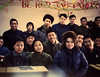
Both Richard and I have been surprised by the relatively few number of foreigners we've seen on this trip. In Beijing and Shanghai, they - we - are numerous, and you'd think there would be a fair number in major cities like Chongqing and Chengdu, but we went days where we were the only foreigners in sight. Even at huge tourist attractions like the Stone Forest. Global economic downturn? Off-season timing? Maybe it has more to do with how we travel - e.g., not in a tour group. But we've walked into places where our very presence created consternation among the locals.

Take the photo above. That was in a Chengdu restaurant not far away from a famous xiao chi ("small dishes") place noted in all the guidebooks. The famous joint had already closed for the night (Chengdu and Chongqing don't seem to be late night cities like Beijing and Shanghai), and we just got in under the wire at this place. The group sitting at the table, mostly restaurant staff, gaped at us. Covertly and not so covertly got out their cellphones and started taking photos. Fair is fair, I thought, so I got out my camera and took theirs.

Back in the day, this kind of reaction was not unusual. Except for in Beijing, where Beijingers even then had a certain sangfroid about the few barbarians in their midst, you were always stared at. Though not with giggles, usually. With intense, close-up appraisals, as if you were some form of space alien just beamed down to their planet. Not threatening aliens, just bizarre lifeforms requiring scrutiny.

Part of it was that we were young and on our own, out on the streets and on public buses and second-class trains and were therefore accessible, unlike the few mostly elderly groups of tourists who were generally isolated from the public, ferried about in mini-buses, fed in private dining rooms. No, we wandered around and got lost and poked our noses into places. It was intense everywhere, but the first place it felt really over the top was in Inner Mongolia, which had only recently been opened to "foreign guests." A guy on a bike saw us walking down the street in Hohhot, wondering about the piles of winter cabbage heaped on the sidewalks, did a double-take, spinning his neck around like Linda Blair in the Exorcist and literally fell off his bike. We went into an empty store that sold about three things - it was bare cement, hardly lit, a couple shelves and a counter - but they had these nifty brass hand scales to weigh herbs (I still have mine, hanging from a beam in my house). We'd been in there all of five minutes when the crowds started showing up. And I mean "crowds." A hundred people? Two? They pushed into the store, four to six people deep, just to get a close look at the aliens. The same thing happened during Spring Festival in Kunming. I have photos of this, of people surrounding Paul, surrounding me, standing inches away, hands clasped behind their backs, staring.

Or...speaking of Chengdu...I had to use a toilet. We were in a public park. I couldn't tell you which one; like every other city I'd seen back then in China, Chengdu has changed beyond recognition. This was a simple brick building with troughs and low walls maybe one foot high dividing them up, no doors, so there was no real privacy. No electricity that I recall, the light provided by a few ventilation windows up high on the walls. In spite of this, I remember a woman squatting there, doing her business, reading the paper.

When I walked in, the women there, three or four, stared. Just curious. They'd never seen somebody like me do this before.

This got to be kind of stressful after a while. Sometimes I just wanted to be anonymous, to disappear, but that wasn't possible. What made it particularly hard at times was the way that you couldn't just be you. Instead you were half-human, half-symbol, representing something much bigger than yourself. I felt this particularly when giving lectures at colleges in Beijing, and during my teaching tenure. I was the first American, or one of the first, that these people had ever met. I remember one day, all fired up, I gave a lecture about, I dunno, the Bill of Rights and the importance of the rule of law - I'd been inspired by an article I'd read written by Arthur Miller, who had traveled in China earlier that year. The students seemed interested in my first class, so I repeated it for the second two. Afterward, I was horrified by what I'd done. The Bill of Rights? The Rule of Law? I'm talking about this stuff in China?! It wasn't so much that I might get in trouble as the trouble I worried about causing others; that, and I barely remembered high school civics, so who was I to talk about such things?

On the other hand, other students I'd met, students of Paul's parents, quoted Thomas Jefferson at me, which was pretty disorienting too (I wrote a little more about this a few years ago).

China has changed so much so quickly that I still get disoriented these days, but over different things.

For example: a few nights ago, we went to a gay bar. I've been to plenty of gay bars and discos in my life; that's what artsy chicks of my generation and place of upbringing did. But an above-ground gay scene in China - I knew that it existed but was still bemused by it all. Ear-splitting dance music, disco ball, and drag show. And definitely one of those places where a couple of laowai walking in turned heads, big-time. Even one of the drag performers, a very cute young man wearing a gold lamé Speedo and gold cape broke character and winked at me. Interestingly the bar's patrons were both gay and lesbian, with groups of seemingly straight couples as well, out for a little cultural tourism and slightly transgressive fun.

In a couple of days I'll be heading up to Xinjiang, to a place where I'm told they are not at all used to seeing foreigners. I'm expecting stares, and that's okay. Once again, I'm giving a lecture, which makes me kind of nervous. Not about the rule of law or anything like that, mostly about my home state, California and former industry (film & TV). Like I'm some kind of expert, which I'm not. Just a wandering alien with an odd knack for showing up in unexpected places.

Wednesday, February 25, 2009

Canine public service announcement?

I'm not sure what to make of this...

Walking from Wuhouci to Du Fu's Thatched Cottage (more on that later), I encountered a couple in their thirties walking their dog. It's no longer unusual to see people with pets in China - the popularity of dogs in particular has skyrocketed the last few years. On this trip, in every city I've visited I've seen so many urban Chinese taking their dogs for a walk - well-groomed, well-cared-for and obviously well-loved dogs.

However, I have never seen a golden retriever carrying a ribbon-decorated basket with empty plastic bottles and a few plastic wrappers. Neither had anyone else around me. As I followed the couple and the dog, others would notice and laugh and point.

The dog seemed to take this duty very seriously. Once a wadded-up piece of plastic blew out of the basket - the dog put the basket down, retrieved the plastic and put it in the basket. Even his owners laughed at that.

I didn't have the sense they exploited the dog. The woman in particular seemed very attached to the retriever, hovering anxiously and clutching a handful of ear and fur as they crossed a busy intersection.

I'm at a loss to explain it, except that maybe the woman was some sort of urban environmentalist, making the point that if her dog could pick up trash and recycle it properly, so could everyone else, dammit...

More tomorrow. I'm tired.

Tuesday, February 24, 2009

More PANDAS!!!!!!!

You got a problem with that?

Richard has moved on to Xian, and I'm here in Chengdu for a few more days, waiting to take the train to Urumqi. I was surprised at how scarce the tickets were, even for soft sleeper - or maybe that's not so surprising, given that this is a full two days of train travel. If you have the money, you're going to want soft sleeper, and I am not expecting that to be particularly comfortable for that amount of time either. But heck, it's an experience, and why else am I here, if not to collect a few more interesting ones?

I decided to change hotels for the rest of my stay here. Honestly, the place we were in before was really nice. They give you fruit baskets! And robes. But the part of town it's in, the Zongfu Road shopping district, isn't that interesting. So I've moved to the Southwest, in the "Jinli Recreation District." This is not "recreation" as in the, having fun, playing badminton sense, but rather, the recreation of historic styles of architecture. It's very touristy (almost entirely Chinese tourists - laowai are in short supply here, something I'll be posting about later), but undeniably charming, and it sits in a really interesting neighborhood.


Tibetans live here, maroon and saffron robed monks strolling up and down the streets, talking on their cellphones, cowboys with leather hats and stuffed grimy duffels buying lamb skewers and flat-bread from a tiny Uighur storefront. I bought some skewers myself, cooked fresh over a metal half cylinder loaded with ashy coals, by a very pregnant Uighur woman who I'm pretty sure speaks less Chinese than I do. Two skewers cost two kuai, about thirty cents. Then for good measure I walked down the block and bought a meat pie thing - one kuai. So far, so good on the digestive front. I did discard the bottle of water I bought at another stall - not a local brand but one I've had a number of times. The cap opened far too easily and the water was filled to the top. I've read about cases where unscrupulous operators refilled old bottles with tap water, and though this bottle could have been fine, I decided it wasn't worth risking my health for 1.5 kuai. Though I guess you could make the argument that I did that with the street food. Oh well.

Monday, February 23, 2009

Sunday, February 22, 2009

In a word, "Stygian"

(that title's for you, fellow Wombats!)

Chongqing bears little resemblance to the city I visited thirty years ago. Even the natural landscape has been altered or obscured, and made unfamiliar. "Chongqing is a mountain city," my friend Xujun would often say, but development blocks the mountain views. Even the Yangze is smaller than it once was, its banks filled to make room for yet more development.

Of all the Chinese cities I've visited, I've never seen one that more closely resembles Ridley Scott's "Bladerunner." A dank fog shrouds the city much of the time, making the mornings dark. Rank after rank of impossibly tall, impossibly skinny apartment buildings, crammed so close together that sunlight could barely penetrate, that I swear you could stick your hand out your window and shake hands with your neighbor across the way. Add to that the chaotic traffic that overwhelms the streets and highways, the city's layout that follows no discernible plan - all it needs are a couple of omnipresent blimps with video advertising (there are of course massive video screens on the sides of buildings and the requisite giant LED signs, at least).

It's fascinating, in a dystopian kinda way, and down in individual neighborhoods, actually pretty pleasant, with abundant street-life, trees and in the newer areas, charming landscaped areas that I still find a rarity in Chinese cities.

Thirty years ago, Paul and I had come to Chongqing to meet up with his parents, who were on a vacation tour provided by their university for Spring Festival. We thought it might be fun to travel down the Yangze with them, be taken care of for a while. Traveling in China at that time was very difficult - they were not at all used to independent travelers, for one thing, and we spoke very little Chinese.

Also, no one had warned us about what it was like to travel during Chinese New Year. Who knew that about half the population of a billion plus Chinese left where they were and went someplace else, all at the same time? Looking down at the Chongqing river docks, watching the ferries load up, resembled a scene out of some World War 2 documentary: refugees fleeing the encroaching Japanese, carrying any and all of their belongings they could manage tied up huge bundles, lugging entire doors and lashed to carry-poles, television sets. Okay, the television sets do not fit the WW2 comparison. But it seemed impossible that these mobs of people and all of their things could fit onto the ferries they tried to board.

We stayed at a place that stuck in my memory for years, because compared to most of the "proletarian" architecture of Chinese cities at that time (Soviet Russia, you have a lot to answer for, architecturally), it was a memorable building: a giant round palace that resembled a carousel, topped by a gold knob. It's still standing today, much remodeled:

The main building is actually a theater. The hotel was in outlying wings. Like most everything else at that time, the facility was rundown and mildewed and overwhelmingly beige, though I do recall new, boxed television sets piled in one of the hallways, waiting to be installed.

My main memories of Chongqing thirty years ago are these:

We visited a number of revolutionary historical sites. This was much more interesting to me than you might think. Though my knowledge of Chinese history was sketchy at best when I'd arrived in China, I'd become fascinated by the late Chinese Premier, Zhou Enlai - I still am, in fact. At the time, amongst the teachers and returned students I knew in Beijing, Chairman Mao was not very popular. Once, in fact, Paul's parents threw a "White Elephant Party" for the teachers whom they worked with and taught advanced English. This is when you bring something you don't want any more and give it away, in exchange for something that somebody else doesn't want any more. One of the teachers pulled out a bundled handkerchief. Wrapped in it was a pile of Mao buttons. He grinned, then chuckled and said, "White elephant."

Zhou Enlai, on the other hand, was still regarded as "the Peoples' Premier," one of the few sympathetic figures in the upper echelon of the Party's leaders, the man who'd tried to keep the country running and who mitigated some of Mao's worse excesses. This is not an entirely accurate representation of Zhou's role during this time - he was nothing if not complex, and it is impossible to summarize anything about him so neatly - but it is not entirely inaccurate either. I'm always drawn to ambiguous characters, especially those with a hint of tragedy.

He was also very handsome, with an actor's ability to portray emotion. "I think that is part of why I like him so much," Xujun said to me recently. "I just like to look at him." Me too.

I got into the habit of buying any Zhou Enlai souvenirs I could get my hands on - not many, compared to the masses of Mao memorabilia left over from the Cultural Revolution - some posters and some buttons and a couple of thin books and comics about his early life. I'd also ask people what they thought of him. There had to be something bad about the guy, some dirt. One person reluctantly told me that "maybe he had a girlfriend who was not his wife. But maybe this is just a rumor." I sort of hoped it was true. You don't want a person to be perfect.

Zhou spent a lot of time in Chongqing during World War 2 the Anti-Japanese War, as the Communist representative to the Nationalists during the United Front period, mixing with Allied diplomats and journalists, spies and underground organizers.

So I was really happy about getting to see Zhou Enlai's office. Zhou Enlai's bedroom. Even Zhou Enlai's bathroom (I have a slide to prove it). My memory of what and where these places were, exactly, was pretty hazy.

Thirty years later, Xujun took me up to the Red Craig Village. This was the Communist Party Delegation headquarters during the United Front Period. Up in the mountains, overlooking the modern city at a distance, it's really a beautiful spot. Peaceful.

"Did you visit this before?" she asked.

I couldn't remember. I wasn't sure. Nothing looked familiar. It didn't look unfamiliar either. I just didn't recall. "The place I went to might have been in town," I said.

"Maybe it didn't make a big impression on you," Xujun said.

This wasn't the case, not really, but it was thirty years ago, and my memory has always been spotty and strange when it comes to recalling events. Ask me about song lyrics and tunes, trivial factoids, foreign languages, all that stuff I remember and remember well, but what I did yesterday, not always so much.

We wandered through the main building, looking at the photographs, the offices, the staff sleeping quarters. Here was Zhou Enlai's office. I wasn't sure if I'd seen it before or not. He did have another office in the old downtown part of Chongqing. Maybe I'd never been up here before. The office was blocked off by two stanchions with a retractable ribbon barrier. The bedroom was through a doorway at the back of the office. "Go in and take a photo," Xujun whispered. "Come on, I'll stand guard!" I didn't want to - I'm a great believer in following the rules - but finally I agreed and went in.

The bedroom is small, taken up almost entirely by the bed, at the bottom of a short flight of stairs. Now that looked familiar.

When we got to the library, I knew.

There on the wall was a framed piece of calligraphy, the characters done in an unusual, "modern" style. I'd seen this before. I remembered it exactly. I'd been so struck by the unusual form of the characters, the almost whimsical modernity of them, that I'd taken a slide. Now, here they were. "Now I remember. Yeah, I've been here before."


As I explained to Xujun, there was another reason that my memories of Chongqing were a little hazy, and that was because I got violently ill the next day. I felt a little out of sorts in the morning, when the group was going off to tour someplace else (I have no idea what or where) and decided that I'd stay at the hotel, beige and mildew and all. Shortly after they left, I started throwing up. I swear it was the soggy cauliflower and gristly pork dish we'd had the night before. Whatever it was, I kept throwing up, and by the evening I was really in sad shape.

It was determined that I should go to the hospital and see a doctor.

At this time, it was almost impossible to travel in China without being assigned a "minder," usually from Liuxingshe, the official China Travel agency. Paul's parents school group had two graduate students who traveled with them. In addition, different minders took care of the group in different cities.

The Chongqing minder was a piece of work. In years he wasn't all that much older than I was, late twenties, thirty at most, but he was a thoroughly nasty little man. I don't know why he hated us, what we'd done that had provoked his ire, but loathe us he did.

So, I had to go to the hospital. He was to escort me there. Paul came along too. He didn't arrange for a car. No. We were to walk. It was freezing cold. The streets were frozen mud. No sidewalks. Hardly any streetlights. Now and again workers pounded bricks and metal for some mysterious purpose that required them to work long after dark.

I'd walk a half a block, boots crunching in the icy mud. Stop. Grab onto a pole or a fence or whatever I could find. Throw up. Walk a little further. Throw up some more. Walk. Shiver. Puke.

We got to the hospital. It was not reassuring. A concrete block building, bare slabs of gray cement. Dimly lit, the occasional bare bulb. No decoration. The exam room had a steel table and a chair in it and not much else.

The doctors and nurses, however, were very nice, wonderfully kind, in fact. I immediately felt better, especially after they gave me a shot of some sort and some pills to take. They spoke to our minder, with Paul hovering in the background.

The minder turned to me and smiled. "They say they think you have appendicitis. They say you might need an operation." His face loomed over mine. "Are you scared?"

I had to laugh. "What do you think? Like I want to have an operation? Of course I'm scared."

He retreated.

"I don't think that's what they said," Paul whispered to me. "I think they said it might be appendicitis, if it doesn't get better."

And in fact, that's what the doctors had said. If I didn't feel better in a day or so, I should come back, just to be sure it wasn't something more serious.

Forgive me, Chongqing. I've thought badly of you all these years. It wasn't your fault. I'm glad I had a chance to return, to experience the warm hospitality of my friend and her family, your earthy streets and docks, Communist museums and memorials, and of course, Zhou Enlai's bedroom.

Saturday, February 21, 2009

Free range foreigner....

Quick post to say we've arrived in Chengdu, checked into our lovely hotel - it claims only to be three stars, but we'd rate it a four - it has robes and actual coffee cups with saucers and SPOONS! Though we are still puzzling out why they also rent rooms by the hour. Honestly, it doesn't look like that kind of place, faux French name aside.

The staff here doesn't speak a word of English. This was a bit of a disadvantage when I got a phone call, shortly after going to my room, from a very pleasant-sounding woman who asked me if I wanted to arrange for a shower and something else I didn't understand. Now, if I were a man, it would be pretty clear what she was calling about, but after I said, "I'm sorry, I don't understand, my Chinese isn't very good," she chuckled and said, "Then I will say it slowly so you can understand." And again asked if I would like to arrange for a shower and some other services that I still couldn't understand.

Now, there is a whole bath house culture here in China that is in no way sexual. Back in the day when most Chinese people did not have decent facilities in their homes, the communal bathhouse was where you went to shower and shampoo and shave and get exfoliated and massaged and what have you. I actually experienced this for the first time in Kunming. Quite a trip. Not for the shy. The sexes are segregated, but you still spend a lot of time standing around naked. The facility is mostly white tile and wood tubs and dim lighting, giving it a slightly subterranean vibe. I went ahead and splurged for the "milk bath" and was thoroughly exfoliated, all the while bumbling around, not knowing what to do and pretty much making an ass of myself. Unfortunately I didn't have time to experience the "Xiuxi Ting" - the "Rest Hall" - where the genders can mingle and chat and snooze and watch TV after their showers - and then go back down to the bathhouse and shower and exfoliate some more.

Anyway, if you are a man traveling in China, you will more often than not receive calls in your hotel room for "massage," and it's well-understood what this actually means. But as a woman...I'm clueless. What was I being offered, exactly?

The other odd thing about this hotel was that no one asked me for my passport. Richard, my traveling companion, had made the reservations, so they wanted his passport (and credit card, for the deposit). I stood there, passport in hand, because in the past, regardless of who made the reservation and who left the deposit, you had to show your passport.

But no request came for mine.

So here I am, in this genuinely charming and well-appointed Chengdu hotel room, wearing the hotel robe and disposable slippers, and I am anonymous. No record of my arrival or of my stay here.

Free range foreigner...

Friday, February 20, 2009

"Stool Room"

From the bathroom on the Dali lake cruise boat. I only wish I'd gotten the one from Li Qun Peking Duck restaurant in Beijing that reads, "No shit!"

Thursday, February 19, 2009

Live from Chongqing...

Greetings! We're settled in here in Chongqing, a process made infinitely easier thanks to Xujun Eberlein, her sister and friends. They picked us up at the airport, reserved rooms for us at a very nice hotel (and for a great rate too) and generally are being incredible and gracious hosts. Xujun is the author of the award-winning collection of short stories, "Apologies Forthcoming" (I interviewed Xujun here) and writes the always illuminating blog, Inside Out China - currently and somewhat mysteriously blocked in China.

This is my second visit to Chongqing. The first was in early February 1980. I can honestly say that I'm already having a better time than that first experience, which I'll try and post about tomorrow. Right now, a full day of travel from Dali involving just about every form of transportation but a boat and a donkey cart has got me pretty wiped out, and I'm going to take advantage of this lovely, quiet hotel room and get some sleep.

Wednesday, February 18, 2009

Your intrepid correspondent in Dali


Okay, I get it. Yes, it's commercialized. Yes, older Bai women in their "ethnic minority" costumes come up to you and whisper, in the lowest, sweetest of voices, "Ganja? Hashish?" - it's like your Granny the Pot Dealer - and you'll want to stay off Fuxing Lu, which is a tourist trap. But seriously, what's not to like about Dali, Yunnan? Beautiful old town, carefully restored, minimal traffic, great restaurants and bars with a cosmopolitan vibe, clean blue skies, huge blue lake, mountains...and did I mention Granny the Pot Dealer?

Not that I took advantage of that or anything. Really! I didn't. And I don't know that I would recommend you do either.

But I would definitely recommend Dali as a wonderful, relaxing and inexpensive getaway. It doesn't surprise me that some travelers come here and forget to leave.


And while you're here, check out "The Caffeine Club" (no website yet, they're working on it), run by Georgia USA natives Chris and John.

Super-nice guys who run a friendly, relaxed place down on the quiet eastern stretch of Renmin Lu. The entire street is worth a walk, and it's a nice change of pace from the more developed western end, full of local shops and only an occasional tourist.

We had a great time today, cruising on the lake and getting lost in the outskirts of town, where the marble cutters work. I often think that getting lost is the best thing you can do while traveling.

And yeah, I'm eating a fish on a stick. Why do you ask?

Monday, February 16, 2009

Reporting from Dali, Yunnan

We arrived early this AM at Dali, which I gather is a sort of hippie/bohemian/backpacker paradise. I haven't seen enough yet to confirm that, but we have a very nice hotel in a traditional courtyard, probably the nicest appointed room I've ever had in China (needless to say, I am not a five-star traveler).

I'm still settling in and will try and post in greater detail later today.

Sunday, February 15, 2009

Why did the laowai cross the road?


"'Black' car. Not safe," the middle-aged woman told me, as she washed the rear window of her taxi. "You understand my meaning? 'Black' car not safe."

"I understand," I told the taxi driver. But the 'black' car - illegal, or to frame it more positively, an example of private enterprise contributing to China's unique brand of capitalism with socialist characteristics (or is it the other way around?) - would take us out to the Stone Forest for 350 yuan - 50 yuan less than the off-the-meter taxi.

"Black car, taxi, it's all the same," the tout who had hooked us up proclaimed. She and her partner, another woman in her thirties, waited by the public bus station, waylaying travelers who couldn't get where they need to go on the bus, which at this point included us.

Even though we'd been assured by several knowledgeable locals that we could catch a bus to the Stone Forest any time of day at the public bus station near the train station, like so many things in China, just because someone tells you something with authority doesn't mean it's true. In fact we would have had to have caught a bus for the Stone Forest this morning, one of those ubiquitous white mini-busses that waits until it's full-up before departing.

"A car is a car," the tout continued. "It's perfectly safe." She led us to the driver, a stocky man with a greasy head of graying brown hair and one of those stiff, boxy Chinese sweaters that defies characterization - it's not at all clear where this non-fashion comes from, what it's trying to emulate. It just is.

The car looked okay, an aging black AudiVolkswagon Santana. Back in the day, not too long ago, these Volkswagons were top of the line. Now they've been supplanted by silver Beamers, Audis, and for reasons that are hard to unpack, Buicks.

Once we wound our way through construction sites and half-built roads more unpaved than not - Kunming's traffic is notoriously bad, partly because the infrastructure has yet to catch up with the volume of cars - it was a quick trip to the Stone Forest was on a new highway, taking a little over an hour. Far different than my first trip here. No highway that time. I don't remember much about that trip, except that it took many hours. I can't even say for certain how we got there, I think by an aging public bus, dirt-white trimmed in red, but the ride was long enough and hard enough that you had to spend the night out there, in a guest house with shabby bungalows painted that particular shade of light green. After watching the "ethnic minority" dances and singing "Rocky Raccoon," we'd retired to our room and drunk "balandi" to celebrate my birthday, then gone home the next day.

Of course I didn't recognize any of the complex around the entrance to the Stone Forest. I doubt if any of it was there nearly thirty years ago, though much of it is old enough to suffer from "White tile disease," that late, unlamented period in Chinese architecture where nearly every public building was fronted in white tile.

We agreed to meet the driver back by the car park in about an hour. That was all the time we'd need.

At first, I wondered how the hell I was going to do what I'd come here to do. I'd brought Paul's ashes in an old hong bao, complete with two gold-foil covered chocolate coins, tucked in my jacket pocket. By the time I'd reached Beijing, the hong bao had started to leak, so I'd put it inside a Baggy. I already worried about being conspicuous. But as we entered the Stone Forest, I wondered how I would manage to do this at all. A wide road wound around hills and limestone spires, shuttle busses driven by young women dressed up in ethnic minority costumes. Tour groups were everywhere, hoards of them, led by guides with pennants and loudspeakers. Was this it? Could you even get off the main road? Was I going to have to scatter ashes dodging tourist mobs taking photos of each other and eating snacks?

Richard and I walked up the road a pace. The sun blazed down on us. It hadn't been nearly this warm when Paul and I had come here thirty years ago. We'd been thrilled that it was warm enough to go without long underwear and gloves and a scarf, but now, it had to be at least 75 degrees.

We came to something called the "Bushaoshan Hill Scenic Area." The signboard pointed toward a narrow stone path that headed into a thicket of stone spires and roughly paralleled the larger road. We followed the path. It wound up the hill, at times leading through passages so narrow that I had to take off my pack and walk sideways.

At length we came to the highest point of the path. From here you could see for miles. It was quiet. No tour groups came this way. Just the breeze.

This seemed like the right place.

I unsealed the Baggy, now gray with the dust of Paul's ashes. I opened the hong bao, spilling some ashes on my hands in the process. The breeze gusted up from the valley below, blowing some of the powder back into my face, onto my camera. I scooped out a handful. Said nothing. Didn't think in words, either. Just, "this is for the beautiful part of you, Paul." I let the ashes go. Put the two gold coins on a rock. And said goodbye.


I took a few photos after that, laughing a little because some grit had gotten into the lens ring, and the top of the camera was powdered with ash. Well, Paul had been a photographer at times in his life, and hey, I'd purchased the service contract on the camera (an Olympus E-410), after the saleswoman had lectured me on how easy it was for dust to get inside these things, and how that could really screw them up.

After that, we headed for the exit, where the driver waited, and then we got on the highway back to Kunming.

Shortly after we'd passed through the toll entrance marking Kunming's official boundary - an outer suburb far from the city center and our hotel - our car sputtered to a halt. Right in the middle of the main highway into Kunming.

"Aiya," the driver muttered. He tried to start the car. It cranked anemically. Not even close to turning over.

"Oh, great," Richard said. "I've seen cars run right into stalled cars in China. It happens all the time. Like that truck behind us."

"Shit. Fuck. Shit." Lots of honking. Cars and trucks slowed, swerved around us.

"Seriously," Richard said. "I've seen it more than once."

Big blue construction truck. Honk. Swerve.

"Okay, that was close."

The driver, meanwhile, got out of the car, casually as if he'd broken down in a parking lot, popped the hood, checked the oil.

"Should we get out of the car?"

"Let's."

We waited until the lane to our left was clear and climbed out, pressed against the median wall while the driver continued to mutter and putter with his dead beater Audi.

Meanwhile, a worker in a yellow safety vest and hardhat waved for us to cross the highway, shouting something that I couldn't make out. Even if I could have heard him, I probably wouldn't have understood him anyway. Yunnan dialect bears little relationship to Beijing Mandarin.

Cross the highway? It's one thing to walk out in the middle of traffic on your typical Chinese street. There's a sort of art and flow to it, and while I can't say I'm totally comfortable, I've learned to adapt. But not this. This was a fucking freeway.

Except here, there were people hanging out on the side of the highway, near the exit. I have no idea why, what they were waiting for. A guy on a motorcycle weaved over, smiling, gesturing at his seat.

"I don't think so," I said.

Finally the worker walked across the highway. No big deal. Gestured for us to come with him. We did. He held up his hand at the oncoming cars and massive diesel trucks, and they slowed and stopped, and we followed him across.

"You can catch a taxi," the worker said, pointing off in the general direction of the exit, then pointing again at the motorcyclist, who grinned at us, showing tea-stained teeth. Then he and another worker started pushing the crippled Volkswagon over to the nearly non-existent shoulder.


We just stood there, not sure what to do. Walk down the exit? Look for a taxi? Were we even in Kunming proper?

All the while the motorcyclist waited, grinning. Another motorcyclist had slowed and stopped to watch the fun, along with a couple of young men who'd been hanging out by the exit. "You can take taxi," the worker said, returning with the driver.

"I'll take you to a taxi for 10 yuan," the motorcyclist said, again, patting the seat of his cycle.

"The two of us?" Richard said. "This is big enough?"

"Big enough," the motorcyclist said, grin even bigger. "No problem."

"Go with him," the worker said, "just give him-" meaning the driver - "his money."

"No way I'm paying him 350 kuai," Richard said.

"How much?" I asked the driver.

"350."

"350?" I said, incredulous. "Why should we give you 350? Your car broke! This isn't the train station! We're not giving you 350!"

"350!" the driver insisted.

"We're not at the train station!" I yelled back.

"I'll give you 300," Richard told him. "That's all."

The driver took it, not at all happy with the situation, but what was he going to do? "I shouldn't have even given him that much," Richard said. The two of us walked towards the off-ramp.

The second motorcyclist, a middle-aged man, cruised past, busting a grin. "You speak good Chinese," he told me. More to the point, I'd provided some good entertainment.

"I've got a long way to go!" I said, laughing.

We did have a long way to go. The exit led into what looked like an industrial park - not many buildings, not a lot of traffic and certainly no taxis cruising by, just our friend, the first motorcyclist.

"I'll take you to a taxi," he said again.

Richard presented both sides of the argument.

"Are we really going to do this? How can both of us fit? But we might never find a taxi out here."

So we said okay, and climbed on the motorcycle, me first, holding onto the driver, Richard behind me, grasping the carry-rack behind him, long legs just skimming above the asphalt.

"Please drive slowly," I requested. "Man zou!" The motorcyclist wasn't offended by my back-seat driving, mainly because for whatever reason, I couldn't stop laughing as we puttered down the off-ramp, all three of us on one underpowered Chinese bike, and onto the street. "If we don't die, this'll be a great story to tell our grandchildren," I babbled, "not that I'll ever have any grandchildren, but you know, the if we don't die part..."

We passed a bus stop, swooped around a couple busses, turned a corner, then came to an intersection. Across the street, heading past us, was a taxi.

"Hey!" the motorcyclist shouted, waving madly. "Shifu! Hey! Ting che!"

The taxi stopped, practically in the middle of the intersection, and so did we. I gave the motorcyclist his 10 yuan, and then asked if I could take his picture, "because you are our hero!" It's a little blurry because I had to take it in a hurry, since we were sort of tying up traffic. But you can see his smile.

Saturday, February 14, 2009

"Flush!"


Found in a Kunming bathroom.

Friday, February 13, 2009

On the road to Kunming...

Sitting in the Beijing Capital airport last night, waiting for our flight to Kunming, it was a really different scene in the domestic terminal than my more typical international experience. I think we were the only foreigners, and many of the Chinese people that waited there lacked the polish of the up and coming Beijing urbanite. You got the sense that this was a provincial crowd waiting to go home.

I kept watching one family, a little boy, maybe four years old, his parents and an older man in PLA green whom I assumed was his grandfather. There was something just a bit disturbing about the tableaux. The mother was young, attempting fashion with cigarette leg jeans, stiletto heels and short jacket with faux fur collar, but it was all a bit worn and cheap. She had the remains of a black eye. The father, big, stocky, a slightly puffy round face, had knock-off basketball shoes in the strangest shade of tomato orange. His clothes needed a wash. Meanwhile the little boy was gleefully hitting his grandfather with an empty plastic water bottle. The grandfather played back; obviously he doted on the kid, but finally gathered up the boy and hugged him close, as a way to stop his hitting. It was the boy's playing at violence that disturbed me, when I considered his mother's black eye.

I was really tired so I just sat and watched and thought about nothing much, mostly the odd commercials for "Great Wall Red Wine" running on the airport video screen - attempts at sophistication that didn't come off - this plonk ain't fine Bordeaux, people, but of course the intended audience wouldn't know the difference - and the running crawl from China Aviation Authority warning passengers to watch their bags and "not take other peoples' stuff."

I happened to glance at the family across the way. The little boy's pants were down around his ankles, and the father held the empty water bottle so he could pee into it.

It's not like this kid was an infant, and the bathrooms in some other far away terminal - they were right there behind them, a few short yards away.

We got onto the plane - buses, rather, to take us to the plane - through a series of rails that looked like a line at a bus station. Richard and I were the only laowai on the flight. As we waited for everyone to get seated, a teenage girl came over and asked if she could take her picture with me. Now, this sort of thing often happens when you encounter Chinese people who aren't much used to Westerners, but I was a little surprised to find it on a flight from Beijing to Kunming.

She was sweet, and so was her friend, and it made them very excited and giggly, so what the heck?

"Maybe they think you're famous," Richard said.

It seemed to take forever for passengers to settle in. In fact, as the plane pulled away from the terminal, there were at least 10 passengers up and around, all the flight attendants too, and as we taxied towards the runway, they showed no signs of sitting down; a half dozen of them were arguing with each other and several of the flight attendants, and as for the other standing passengers, occasionally a flight attendant would pass by and say in desultory fashion, "Mashang zuoqilai."

I would not have been too surprised if they'd stayed in the aisles for the whole flight, but finally, just before we gathered speed for takeoff, everyone sat down.

Thursday, February 12, 2009

On to Kunming

I've had a busy time since arriving in Beijing, bar-crawling, um, meeting with friends and colleagues. Right now I need to pack, check out of this hotel, meet my friend the Peking Duck and go to a Chinese class. We fly to Kunming this evening. I hope to have five or ten minutes to write something a little more illuminating than this.

Tuesday, February 10, 2009

Greetings from Beijing...

I'm mostly settled in at my run-down but charming hotel in the hutongs. The weather here is unseasonably warm, making me wonder if I will even need the Sorel boots I schlepped in my minimal luggage - which, in spite of my planning and best intentions, is still too damn heavy.

I hadn't made many plans for my few days in Beijing but the days are already pretty filled up, so I'd better get going. Chinese class now, blogger dinner later. Tomorrow, a late CNY dinner with a friend (I need to find presents!) and if I can swing it, I'll drop by the latest Beijing Tweet-up.

Friday or thereabouts, I set off for Kunming. After that, I will work my way north to Xinjiang. I will, internet access permitting, keep you posted.