Wednesday, November 30, 2005

Springtime In Harbin

The Harbin water crisis is far from over, according to this article from the AP:
A top Russian environmental official tried to reassure the population Tuesday by drinking a glass of water on television. But a spokesman for the World Wide Fund for Nature said the river faced "ecological catastrophe" from the 50-mile-long slick of chemicals floating toward the Russian border from China.

"There will be an effect on nature plants and fish will die and economic damage," said Ilya Mitasov, a Moscow-based spokesman for the global environmental organization.

The pollution will result in massive fish deaths and force city residents and industries to search for alternative sources of water, he told The Associated Press in a telephone interview.

The only way to get rid of the toxic chemicals including cancer-causing benzene is evaporation, but the water temperature would have to be 68 to start that process, Mitasov said. Currently it's about 50 and there is ice on some stretches of the river, which ultimately feeds into the Sea of Okhotsk.

"The benzene will remain in the ice until spring, and the (situation) will be dragged out," Mitasov said.
Meanwhile, Der Spiegel (via the invaluable Salon.com) features this grim summary of the evironmental costs of China's economic miracle:
Even if water began flowing once again to the city's residents on Tuesday, the horrific environmental catastrophe reveals the flipside of the socialist economic miracle. Secretiveness and sluggish crisis management highlight the price the Chinese are paying for their boom. And even as Westerners envy the half-communist, half-capitalist country for its impressive growth figures and endless backyard market, China is no longer merely the world's factory. It is also the world's toxic waste dump.

China's rise as a global power, achieved with high economic growth rates, is reminiscent of the conditions in the era of early capitalism. Everything that drives production is good, and everything that slows it down -- safety technology, for example, that prevents industrial accidents from leading to massive factory explosions -- is harmful. The result is exploding tanks, burning factories, collapsing mine pits and all manner of toxic leaks. According to official statistics, 350 Chinese die each day in industrial accidents, but the unofficial figure is likely to be much higher. "Occupational safety is a serious problem, because the number of accidents and deaths remains high," said Wang Dexue, deputy director of the State Office of Occupational Safety, commenting on the horrifying figures from the country's manufacturing industries.

Adding to the problems are economic reforms that have made many businessmen greedy. China's laissez-faire brand of socialism doesn't prevent executives from spending their money on cars and villas instead of investing it in worker safety and environmental protection. Although the government is constantly vowing to monitor manufacturers more closely, local officials and party leaders are often in bed with the captains of industry in China. This Mafia-like alliance between the politically and economically ambitious is known as "local protectionism."

Chen Bangzhu, an environmental expert on Beijing's Parliamentary Council, says he recognizes an "irrational development" in his country. In an interview earlier this year, Pan Yue, the deputy minister of the government environmental agency, SEPA, predicted a bitter end to the economic miracle. "This boom will soon come to an end," he said in an interview with Der Spiegel, "because the environment isn't cooperating anymore." The negative consequences of the boom are devastating. Five of the world's 10 most polluted cities are in China. More than two-thirds of all Chinese rivers and lakes are turning into sewers -- even before the recent accident, the Songhua River was hardly a model of cleanliness -- and more than 360 million people have no access to clean drinking water. A toxic soup splashes through the country's waterways, while people living along the banks die from cancer at above-average rates. Nowadays, the then 72-year-old former party chairman Mao Zedong's legendary swimming outing in the Yangtze River in 1966 would no longer be seen as evidence of his strength, but more as a suicide attempt...

...The People's Republic, which could soon surpass the United States as the world's largest producer of greenhouse gases, has lost its ecological balance and is paying a heavy price as a result. About 400,000 people die prematurely each year because of the polluted air they breathe. Experts estimate the annual loss at 8 to 15 percent of the gross domestic product -- or up to $250 billion -- a figure that does not include the costs of treating cancer, skin conditions and bronchitis.

The Chinese leadership has become increasingly concerned about the possibility that environmental damage could jeopardize China's industrial ascent. After the Harbin incident, even Prime Minister Wen Jiabao admitted that the environmental situation is "bleak" and called for "sustainable growth." But many other party leaders see this kind of talk as nothing but Western social nonsense. They prefer to follow the lead of Mao, who summed up his take on the environment in 1958 when he said, "Make the high mountain bow its head; make the river yield its way." Today's comrades, profiting handsomely from industrial growth, believe it is cheaper to clean up in the distant future than to invest in protecting the environment today.
Of course, such attitudes aren't unique to China. I could cite our current Administration in the US, with its disbelief in global warming and its infinite faith in the power of more drilling (and foreign wars) to solve our energy issues. Or, going back a couple of administrations, I could mention former Secretary of the Interior James Watt, who did not think we needed to concern ourselves overmuch with conserving resources for future generations, because in his words, "I do not know how many future generations we can count on before the Lord returns." Such faith is touching, in a way, as is the faith of the Chinese Communist Party's materialists, who believe we can innovate our way out of any crisis we create, or at least can leave the mess for our children to take care of - as opposed to the faith of the Bush Administration, which preaches that the mess simply does not exist. But the grownups in the room, in China, America and elsewhere, realize that the longer we wait, the greater the reckoning. Whether the grownups can take charge from the greedy, selfish children who all too often seem to be treating the world as their playpen, before that playpen collapses under the weight of its own filth, remains to be seen.

Saturday, November 26, 2005

China's Press Kicks Some...

So you know how I'm always pontificating about how a grassroots environmental movement has the potential to be a democratizing force in China? Newsweek thinks so too:
In China, where the ruling Communist Party discourages or outright crushes any attempts at grass-roots movements, environmental protection is one of the only areas of activism that is thriving. Led by an increasingly feisty domestic media, some crusading lawyers and a few maverick bureaucrats, the Chinese are beginning to demand information from corporations and their government about the harmful effects of rapid economic development on the environment. In some cases, the public pressure has worked; in a few cases, even the state agency that regulates the environment has joined sides with environmentalists.
More notably, the Newsweek account contains a fascinating chronology of who knew what when, and just how important the role of China's press was in exposing the disaster:
On Monday afternoon, Nov. 21, an editor at one of China’s most aggressive magazines, China Newsweek (not related to this publication), spotted a curious headline on the Internet. Harbin officials had announced they were cutting off water to residents for four days to make repairs. Finding it odd that an entire city’s water supply would be shut down at once, the editor called her boss to brainstorm. Rumors that an imminent earthquake was behind the mysterious “repairs” had been circulating on the Internet, but the two editors’ suspected the recent chemical plant explosion in Jilin was behind the mysterious shutdown. When they consulted maps of the two provinces and the location of the plant, they agreed the two events must be related.

With only 24 hours to press time, China Newsweek called a well-placed source in Harbin, who all but confirmed their suspicions. “He said the river had been contaminated, but the government had not publicized this,” the editor told NEWSWEEK. At dawn, the magazine sent three reporters to Jilin and Harbin to get the story, before the government intervened to stop them. “We knew that if we didn’t do the story then, we might not be able to do it the next week,” said an editor, who asked that she not be named because of the sensitive nature of the situation. “The seriousness of this incident could affect the future of a lot of officials in the Northeast.”

The China Newsweek story came out Nov. 24, about one day after the country’s environmental regulators finally owned up to the contamination that had left more than three million people who lived in and around Harbin without running water. The story provided details about which government officials knew what and when. It reported that the governor of Heilongjiang province had told 400 officials in a closed meeting that the city of Harbin had lied about the water-supply shutdown because it was waiting for permission from higher authorities to disclose the spill and didn’t want to contradict Jilin official reports. And it said that the cover-up ended only after provincial officials in Heilongjiang sent a desperate request for guidance to the central government. The editor of China Newsweek said she hoped the story would show people the harm done by “the conflicting interests of government officials from neighboring parts of the river.”
CDT also links to a fascinating blog from a Chinese journalist, and Jilin native, who provides an insider's look at the factory where the disaster originated. Here's a taste:
The political rumors in Beijing these past few days are that the governor or party chief of Jilin Province and the CEO of CNPC will soon be sacked and replaced. Maybe not so fast. But one thing is for sure: for lower-level bureacrats, heads are going to roll. At least I hope so. Roll, roll, you stupid heads. There has been so many mayors of Jilin in recent years that even my parents lost count. And the local chief manager of CNPC's Jilin subsidiary looks like dead meat. Workers were already complaining so much about this guy. Fascist, was the word the used the most. Apparently this guy, Yu Li, introduced draconian rules and is pathetically obsessed with appearnce: workers are fined when they don't don their uniforms and masks neatly, when they forget to put on a name badge for work, when they don't walk in a straight line on factory grouds -- hell, sounds like first-years at Westpoint. All workers must put down whatever they are doing when there's a snowstorm in the winter, to clean snow off the paths, or somebody will be find. "My first concern everyday was not safe production anymore," a distant relative who works at 101st Factory told me. "It was making sure I look OK for the job. I had to check if I was wearing my badge properly when I rushed to the explosion site during the rescue -- I was afaid I'd be fined even when I was trying to dillute toxic chemicals and save lives."
Be sure to check out the Newsweek article and especially, the blog - there's lots more.

Sorry About That...

From the AP:
HARBIN, China - Visiting Premier Wen Jiabao ordered local leaders to clean up toxic benzene by Sunday night from the river that provides water for this northeast city, where residents spent a fourth day Saturday without supplies in freezing weather.

The foreign minister, meanwhile, delivered an unusual public apology to Moscow for possible damage from the spill on the Songhua River, which is flowing toward a city in the Russian Far East.

Beijing's show of care and contrition was almost unprecedented and represented an effort to restore its damaged standing with both China's public and Moscow, a key diplomatic partner...

...Foreign Minister Li Zhaoxing's apology to Russian Ambassador Sergei Razov was reported on the state television evening news, which is seen by hundreds of millions of Chinese.

"Li Zhaoxing expressed his sincere apology on behalf of the Chinese government for the possible harm that this major environmental pollution incident could bring to the Russian people downstream," the report said.

It was an extraordinary step for the newscast, which usually carries only positive reports about China's foreign relations...
Here's one form of apology I wish corporate wrongdoers in the US would adopt:
The plant was run by a subsidiary of China's biggest oil company, state-owned China National Petroleum Corp., which issued an apology this week and sent executives to help dig wells in Harbin.
Meanwhile, the UK Guardian reports on how the crisis has impacted Harbin's poorest residents:
For the first time in her life Mrs Li is thinking of splashing out on a bottle of water. It may only cost 7p, but for the migrant mother living in one of the city of Harbin's poorest neighbourhoods, anything but tap water has, until now, been an unthinkable extravagance.

Decision time is looming. Since China's biggest recent pollution scare prompted the authorities to cut off water supplies two days ago, the 25-year-old has conserved every drop. She no longer washes the family's hair and clothes. She eats only bread, buns and other food that does not require water for cooking. And, though it worries her immensely, she has stopped boiling her baby's bottle to keep it sterile.

But her family's supplies are already running out. Unlike most of the rest of the city's 3.5 million residents, she had no bath or barrels to fill when the government warned everyone to prepare for a dry patch. Instead, the family of three drink and wash from three small buckets that are fast emptying.

"We can probably manage for a day or two more, but if it goes on much longer I'll be very worried," she said. "I never imagined this would happen when I came to live in the city."...

...Despite freezing temperatures, people queue on the streets with kettles and flasks when the emergency water tanker, a converted street cleaning truck, pulls in once a day with fresh supplies. For some there is even an air of festivity. "It's a bit like the war," says one veteran. "Everyone pulling together and the [communist] party providing for us."

But in the poorer parts of town there is resentment that the burden and the risk are not being equally shared. "It is all right for the rich and the communist cadres," said Zhu Yuan Liang, a scrap collector. "But most people are poor and cannot afford to waste money on bottled water."
The Guardian article also contains an interesting speculation::
The exposure of the cover-up may have been a ploy by central government to make companies and local authorities more responsible for the environment. According to Chinese journalists the order to go public came directly from the state council - led by prime minister Wen Jiabao. A day later Mr Wen held a meeting with ministers in which he emphasised the environmental woes facing China.

It Takes A Village

The Washington Post has an epic recounting of the Taishi protests, detailing the support from outside political activists (including Lu Banglie, whose beating at the hands of hired thugs sparked international outrage) and Beijing intellectuals who came of political age in 1989. The article is too long and too detailed for me to adequately summarize it, but here are a few highlights:
...Taishi has become a milestone in the peasant uprisings that increasingly are breaking out around China, generating open concern in President Hu Jintao's government and in the Communist Party. In Taishi's rebellion, outraged local farmers for the first time received help from outside political activists and Beijing-based intellectuals whose politics were shaped in part by the 1989 democracy movement.

The cooperation between local peasant protesters and veteran activists pursuing a national political agenda -- pushing China toward democracy -- was hailed by Chinese and foreign civil rights advocates as a significant advance. By helping peasants learn from others, they saw a promise of generating more democracy in China's village elections. And by aggressively promoting coverage in Chinese and foreign media through multiple Web postings and broadcasts of cell phone text messages, they thought they had found a way to pressure the authorities. Liu Xiaobo, a well known Beijing activist and writer, said on an overseas-based Web site popular with dissidents, "Civil elites working together with grass-roots villagers created a new method to safeguard villagers' human rights." He added, "Domestic intellectuals and Internet users have provided tremendous support and also brought massive attention among Western media."

But for the government and Communist Party, the coming together of disgruntled peasants and political activists in Taishi caused alarm. It raised the specter of a nascent national leadership and coordination for what so far has been an unconnected series of violent outbursts, usually over local economic issues, each of which has had homegrown leaders without broader ambitions...

...The authorities in charge of Taishi cracked down hard. They sent in riot police to break up protests. They branded the activists as "plotters" and threw several of them in jail on charges of inciting social disorder. Lu was detained for a day even before the beating. The offices of some were rifled, they said, and their houses were put under surveillance. Some went into hiding.

Most of all, the authorities made sure that Taishi remained under the leadership of Chen Jingshen, the elected village chief and, simultaneously, the unelected Communist Party secretary. He was the target of the angry peasants, who charged that he bribed his way to victory in last April's vote and siphoned off thousands of dollars in village funds over the last several years.
Notable is the attempt by the organizers and Taishi's protesters to use China's laws to achieve their goals:
Yang and Lu, two veteran activists, quietly got involved in the struggle. They advised the Taishi villagers on what options were open to them under China's election laws, Lu said, and inspired them by recounting Lu's experience in booting out a corrupt leader back home in Hubei province. Basing their demand on the election law and its recall provision, Feng and Liang filed a formal recall motion on July 29. According to Lu and the district government, the motion was drafted with help from Lu and Yang.

It carried more than 400 signatures, meeting the threshold of endorsement by 20 percent of Taishi's 1,500 registered voters.

Villagers gathered two days later in an open square. From atop a heap of bricks, as local reporters and other witnesses looked on, Feng read a section from Chinese law books saying village accounts must be published every six months and villagers had the right to recall Chen.

"The law will be our guardian," he vowed.
What followed was an escalating series of sit-ins, hunger strikes and protests as the local government attempted to remove the town's ledgers to avoid any outside audit that would reveal village chief Chen's alleged financial improprieties. Riot police eventually cleared the protesters, who included elderly women, using batons and high-pressure hoses. In spite of this set-back, it appeared for a time that the villagers might have actually achieved their objectives:
Then, in a surprise turn of events, the district government announced that the recall motion was proved valid and villagers should choose an election committee to organize a new vote for village chief, scheduled for the middle of October. The protests should now stop, it said, and activists with "ulterior motives" should be ignored.

On first glance, this seemed like a triumph for the villagers. The official party newspaper, People's Daily, hailed the outcome as a model for village elections and pointed to signs of "a democratic environment built upon rationality and legality."

But then the district government arbitrarily chose all candidates for the seven-person election committee -- and all were local officials loyal to Chen.

Outraged, the still-defiant villagers threatened to boycott the vote. Seeking to prevent more violence, the district government swiftly relented and allowed another slate to run as well. The vote was held Sept. 16; all the unofficial candidates were elected and none of the government's slate.

The seven committee members now had four weeks to organize a new vote for village chief. But somewhere in the government and party bureaucracy -- activists believe it was at a senior level in Beijing -- officials had decided Chen would not be replaced, lest a precedent be set.
Under pressure and repeated threats, a majority of the petitioners withdrew their signatures, and the recall vote was canceled.

The article concludes with a quote from Lu, the peasant activist, who vows to continue his organizing: "I will definitely continue. But how to do it is the question now."

Thursday, November 24, 2005

Harbin Update

AP has an update:
The 50-mile-long patch of water carrying toxic benzene began entering Harbin, a city of 3.8 million people in China's northeast, before dawn, the government said. It was expected to take 40 hours to pass.

"After it passes ... we will have to make efforts to disinfect the water," Shi Zhongxin, director of the city's water bureau, said on state television. He gave no details...

...The city government announced it was digging 100 new wells.

On Thursday, thousands of one-liter bottles of drinking water stood in huge stacks outside wholesale shops. Families bought them by the dozen to take home by bicycle, while sidewalk vendors pushed carts straining under hundreds of bottles...

...China's central government confirmed for the first time Wednesday that the shutdown was a result of a "major water pollution incident." Local officials earlier disclosed the reason, but officials in Beijing had refused to comment...

...The explosion, which forced the evacuation of 10,000 people, was blamed on human error in a facility processing benzene, which is used in the manufacture of plastics, detergents and pesticides. Short-term exposure can cause drowsiness, dizziness and unconsciousness.

A top official with China's environmental watchdog said Thursday the company overseeing the plant should be held responsible — state-owned China National Petroleum Corp., which is the country's largest oil company.

"We will be very clear about who's responsible. It is the chemical plant of the CNPC in Jilin province," Zhang Lijun, deputy director of the State Environmental Protection Administration, said at a news conference.

Zhang did not give any more details but said investigators were looking into criminal responsibility.

He also had no details on what authorities would do to protect against long-term damage to the river and surrounding soil.

In neighboring Russia, news reports said concern was growing in the border city of Khabarovsk, about 435 miles downriver from Harbin.

Chinese Foreign Ministry spokesman Liu Jianchao said officials briefed the Russian Embassy twice this week and both sides have agreed to share information....

...Zhang said China did no wrong in waiting until this week to tell Russia about the effects of the Nov. 13 accident. "There are different levels of reporting," he said, explaining that local officials along the river were told first.

"It will be another 14 days before the toxins reach the Heilongjiang River" which flows into Russia, "so we don't think we were late in providing information," he said.

But, an official in Khabarovsk told Russia's Itar-Tass news agency that not enough was known about the accident on the Songhua River — known in Russian as the Sungari.

"Unfortunately, the Chinese side has so far not released full information about the chemicals in the Sungari and their amount," Ivan Sych, head of the Khabarovsk regional department for civil defense and emergency situations, was quoted as saying...

...With its huge population, China ranks among countries with the smallest water supplies per person. Hundreds of cities regularly suffer shortages of water for drinking or industry. Protests have erupted in rural areas throughout China over complaints that pollution is ruining water supplies and damaging crops.
The Financial Times account is grim:
Thousands of residents of Harbin last night jammed its railway station while others booked all available flights as a deadly 80km toxic slick made its way down the Songhua river, threatening to poison the north-eastern Chinese city's water supplies.

The slick of benzene and other toxins was leaked into the river, the city's main source of water, after a series of explosions 10 days ago at a chemicals factory 200km upriver.

A mood of distrust and paranoia was spreading through the industrial city of 9m people, sharpened by the local government's decision to turn off water supplies for four days for fear of an environmental catastrophe.

Trains leaving the city are fully booked until the weekend. All 42 flights from the city's airport were also full yesterday.
The Guardian adds:
While the true extent of the risk to human health remains unclear, the public's sense of unease has been heightened by mixed signals coming from the authorities, who have taken more than a week to raise the alarm...

...The state environmental protection agency said it had started monitoring water safety levels within three hours of the explosion at the plant, yet its report - that 108 times the safe level of benzene seeped into the river - only became public knowledge yesterday...

...in China, questions about the environmental disaster are spreading beyond Harbin. According to the Xinhua news agency, the provincial government is so concerned that it has warned city residents to stay away from the river to avoid possible exposure to airborne toxins.

Upstream, there have been reports that many fish have died and, contrary to earlier denials, it appears that at least two cities, Songhua and Jilin, have shut down water supplies because of health fears.
I'm running out the door and have no real time to comment here. But for me, this has echoes of another disaster from a few decades ago. That too took place in a state that zealously tried to control the flow of information, and the fall-out from the government's handling of it helped trigger major changes in that government.

Remember Chernobyl?

I've said before that perhaps a grassroots environmental movement has the potential to be a dem0cr@tizing force in China. Pollution affects everyone, rich and poor, and in addition there are many in the government who recognize the severity of China's problem and are pushing for concrete actions to address it (check out this interview with Minister Pan Yue). A balance with nature is an essential aspect of traditional Chinese culture as well - something that even Mao and the rush to modernization has not completely destroyed.

China's officials claim they will share information on a timely basis. I imagine Harbin's residents will be very interested to see if they do - particuarly their plans to ensure the future safety of the water supply.

UPDATE And the criticism is rolling in:
Environmentalists criticized the government for failing to take action and inform the public sooner.

"Careful environmental evaluation should have been made to avoid building dangerous factories near residential areas and water sources in the first place," said Xue Ye, general secretary of the Chinese group Friends of Nature.

"The local government should have predicted the possible pollution, but they didn't. It makes us wonder whether the plan was made for real use or just for showing off."...

...Reporters from China's usually docile state press peppered Zhang with questions, asking repeatedly why the government waited so long to disclose the scale of the threat faced by Harbin and other communities.

Zhang replied, "We did report it right away. There are different levels of reporting."

A reporter from China Central Television, noting that China has suffered a string of fatal industrial accidents recently, asked whether the government would be setting up a new emergency-response mechanism.

Zhang said the government already had such a mechanism and that it functioned as planned.

Wednesday, November 23, 2005

Turkey


Turkey
Originally uploaded by Other Lisa.

Okay, so Firedoglake and Dependable Renegade already have this up. But I'm feeling the holiday spirit...

Saturday, November 19, 2005

The Fall of Japan?

In general I've avoided the topic of anti-Japanese sentiments in China. It's such a hot-button issue that it's difficult to have any real debate that doesn't deteriorate into a lot of shouting and slogans. But these two articles, dealing with Japan's increasing isolation from the rest of Asia, are worrying on many levels.

First up is an article from the UK Guardian that explores the connection between China's rise and increasing Japanese nationalism:
When Junichiro Koizumi, the Japanese prime minister, secured his dramatic and overwhelming victory in September's general election, its significance was generally interpreted as a victory for his programme of privatisation and deregulation. This, however, is secondary. Far more important to Japan's future is Koizumi's implicit and incipient nationalism. This was demonstrated again on October 17 with his latest visit to the Yasukuni shrine, where class A war criminals are honoured, despite the opposition of China and South Korea and the wave of anti-Japanese demonstrations in China earlier this year.

Little is made too explicit in Japanese society, but the new cabinet, which Koizumi announced last week, spoke volumes about both his intentions and likely future trends in Japan. The two top positions, chief cabinet secretary and foreign minister, were given to Shinzo Abe, the man most likely to succeed Koizumi when his term finishes next September, and Taro Aso respectively. Both are rightwing nationalists and both, like Koizumi, are regular visitors to Yasukuni. This is the first time that the three key positions in the cabinet have been occupied by such figures. The previous cabinet secretary, who had opposed Koizumi's visits to Yasukuni, was dropped from the cabinet and the former foreign minister, who did not visit Yasukuni, lost his position.

One might think that this is to read too much into such visits to the shrine. On the contrary, they are symbolic acts, an expression of how Japan's past and future should be seen, and as such a deliberate, if coded, signal to the Japanese. Nor are these visits naive or innocent in the message they send to China and South Korea. Koizumi may express the view that they do not give offence to these countries but he knows that they do. And this, indeed, is their very intention. The more these countries protest, the more likely it is that Koizumi will continue to visit the shrine. He is laying down a marker - for the Japanese and to the Chinese and Koreans. Japan's future is already beginning to take shape.

The causes of growing Japanese nationalism may be diverse, but they are increasingly driven by one overwhelming factor: a fear of the rise of China. That is the only way the behaviour of Koizumi and the other leading lights in the Liberal Democratic party can be understood. It could be different. China, widely credited with having pulled Japan out of its long-running recession, represents an enormous economic opportunity for Japan, and is already Japan's largest trading partner. But far more powerful forces than mere economics are at work. Ever since the Meiji restoration in 1868, Japan has turned its back on Asia in general and China in particular: its pattern of aggression from 1895 onwards and the colonies that resulted were among the consequences.

To engage with China requires Japan to come to terms with its past, and Koizumi's visits to the shrine represent a symbolic refusal to do so. Japan is stuck in its past, and its past now threatens to define its future and that of east Asia. Even during the postwar period, when Japan dominated east Asia economically and China was weak and self-absorbed, it never had an influence commensurate with its economic strength. The reason was simple: its failure to atone for its past and embrace a new kind of relationship with its wronged and distrustful neighbours. If Japan could not do it then, it is even less likely to do it in the face of a resurgent China that is rapidly displacing it as the economic and political fulcrum of east Asia.
Even more alarming in this context is the increasingly close alliance that Japan is forming with the United States:
Earlier this year Japan affirmed, for the first time, its willingness to support the US in the event of a conflict over Taiwan. It has also agreed to work with the US to develop and finance a missile-defence system whose intention is clearly the containment of China. It is not difficult to see the early signs of a new cold war in east Asia, with Japan and the US on one side and China on the other.
I think this fear is somewhat overstated. The United States simply has too much of an economic stake in China, and vice-versa. Regardless of neo-con posturing on both sides, China and the US are intertwined in a symbiotic relationship that if broken, will damage both parties (granted, I may be giving too much credit to the power of rational thinking here). And it's not clear to me what the greatest danger of a nationalistic Japan might be to its Asian neighbors (ideas, anyone? I don't see Japan invading Manchuria again any time soon). I wonder if the greatest danger of this sort of isolation is to Japan itself, both economically and spiritually. What this New York Times article says about certain strains in Japanese culture is both alarming and deeply sad:
A young Japanese woman in the comic book "Hating the Korean Wave" exclaims, "It's not an exaggeration to say that Japan built the South Korea of today!" In another passage the book states that "there is nothing at all in Korean culture to be proud of."

In another comic book, "Introduction to China," which portrays the Chinese as a depraved people obsessed with cannibalism, a woman of Japanese origin says: "Take the China of today, its principles, thought, literature, art, science, institutions. There's nothing attractive."

The two comic books, portraying Chinese and Koreans as base peoples and advocating confrontation with them, have become runaway best sellers in Japan in the last four months.

In their graphic and unflattering drawings of Japan's fellow Asians and in the unapologetic, often offensive contents of their speech bubbles, the books reveal some of the sentiments underlying Japan's worsening relations with the rest of Asia.

They also point to Japan's longstanding unease with the rest of Asia and its own sense of identity, which is akin to Britain's apartness from the Continent. Much of Japan's history in the last century and a half has been guided by the goal of becoming more like the West and less like Asia. Today, China and South Korea's rise to challenge Japan's position as Asia's economic, diplomatic and cultural leader is inspiring renewed xenophobia against them here.
There are so many offensive stereotypes and outright falsehoods in these books that I'll stick to the Chinese volume:
The book describes China as the "world's prostitution superpower" and says, without offering evidence, that prostitution accounts for 10 percent of the country's gross domestic product. It describes China as a source of disease and depicts Prime Minister Junichiro Koizumi saying, "I hear that most of the epidemics that broke out in Japan on a large scale are from China."

The book waves away Japan's worst wartime atrocities in China. It dismisses the Rape of Nanjing, in which historians say 100,000 to 300,000 Chinese were killed by Japanese soldiers in 1937-38, as a fabrication of the Chinese government devised to spread anti-Japanese sentiment.

The book also says the Japanese Imperial Army's Unit 731 - which researched biological warfare and conducted vivisections, amputations and other experiments on thousands of Chinese and other prisoners - was actually formed to defend Japanese soldiers against the Chinese.
So does all this justify the recent, and sometimes violent, anti-Japanese demonstrations in China? A cautionary note: one of the book's authors, Ko Bunyu, a Taiwan-born writer who has lived in Japan for forty years, credits the demonstrations with boosting his sales to past the one million mark:
"I have to thank China, really," Mr. Ko said. "But I'm disappointed that the sales of my books could have been more than one or two million if they had continued the demonstrations."
Thanks to David in the UK for the Guardian article!

Tuesday, November 15, 2005

Hu Hearts Hu

Fascinating analysis by the New York Times Joseph Kahn (via the International Herald Tribune) about the pending rehabilitation of CCP reformer (and Tiananmen, "well, it's not really about him, but his death is a good excuse" icon) Hu Yaobang - specifically, what this wrangling over Hu Yaobang's post-mortem reputation signals about the factionalization of China's leadership. And it's not necessarily what you might think:
The Chinese president, Hu Jintao, early this year decided to mark the 90th anniversary of Hu Yaobang's birth. Party observers said President Hu aimed to soften his hard-line image and strengthen the Communist Youth League, his political base within the Communist Party. The youth league was considered the support network of the Hu Yaobang, who lost his position as Communist Party general secretary after a power struggle in 1987. The two Hus are not related.

While restoring the stature of Hu Yaobang is unlikely to lead to broad political openings - the party leadership has steadily tightened its grip over civil society and the media, for example - it does give a glimpse of the complex politicking that takes places among the ruling elite.

It also shows the enduring sensitivity about the people and events connected with the 1989 protests. Political observers say the June 4 killings will haunt the party until it acknowledges having bloodily suppressed the mainly peaceful pro-democracy protests and until it pays respect to the hundreds of people killed, injured or purged as a result of the unrest.

President Hu persisted with marking the anniversary of his Hu Yaobang even though four of the nine members of the Politburo Standing Committee, China's top ruling body, expressed concern that the move could threaten stability, people told about the debate said.

The four, one of whom was Wen Jiabao, the prime minister, were said to have different reasons for opposing the commemoration. But all argued that the move is potentially risky given the circumstances surrounding the 1989 demonstrations.

Honoring Hu Yaobang could give people the idea that the demonstrations, which the party has condemned as a massive antigovernment plot, are open for discussion, these people said.

Opposition to the commemoration was first reported earlier this month by Open, a Hong Kong-based political magazine, and was confirmed by people close to the late leader's family.

President Hu is said to have overruled the objections and ordered the commemoration to proceed, arguing that while students may have invoked Hu Yaobang's name when their protest began, but the former leader had no responsibility for the demonstrations.
With so much ideological freight attached, it's no wonder that arrangements for the rehabilitation ceremony are somewhat complicated:
People close to Hu Yaobang's family said at least three members of the Politburo standing committee will attend the Beijing event...Wen will make an appearance despite having expressed concern that restoring Hu Yaobang's stature could lead to calls to rehabilitate Zhao Ziyang, who succeeded Hu Yaobang as party chief. Zhao, who died last year, was harshly condemned for siding with protesters against the party during the 1989 unrest. He spent the last 15 years of his life under house arrest.
What's especially intriguing about all these machinations (to those of us who follow such things, anyway), is how they turn on their head and invert the typical paradigms by which we evaluate China's leaders and political direction. I mean, if Hu Yaobang equals symbol of reform and liberalization, then supporting his rehabilitation must be a sign of greater openness and reform, right?

Not necessarily so:
Since taking over the party leadership in 2002, President Hu has rejected ideas for political liberalization and pursued a sustained crackdown on the press, nongovernment organizations, the legal profession and religious groups he views as threatening the party's hold on power.

Plans to honor Hu Yaobang prompted some Chinese journalists and party officials to speculate that President Hu might begin pursuing a more moderate governing style now that he has largely consolidated his power.

But many observers said they believe that the president is instead working to shore up the influence of Communist Youth League veterans much as his predecessor, Jiang Zemin, often protected and promoted people associated with the Shanghai party apparatus, his longtime base.
As entertaining as it is to speculate about what this signals regarding China's leadership and its future direction, I will once again fall back on that old Zhou Enlai quote, when asked for his opinion of the French Revolution: "It's too soon to say."

Monday, November 14, 2005

Heroes And Villains II

Dai Qing Speaks! From the excellent Three Gorges Probe:
In early 1989, acclaimed Chinese journalist Dai Qing published Yangtze! Yangtze!, a groundbreaking collection of interviews, essays and statements by Chinese scientists, journalists and intellectuals opposed to the Three Gorges dam. This pioneering critique was later banned in China for allegedly "abetting the turmoil" in Tiananmen Square. Dai Qing was arrested in July 1989 and spent 10 months in solitary confinement in Qincheng political prison on the outskirts of Beijing.

For the past 16 years, Dai Qing has not been allowed to publish her work or to speak publicly in China - until a recent talk at the Sanwei bookstore-teahouse in central Beijing. The following is a transcript of her presentation, along with excerpts from the question and answer session.
And you'll just have to click on the link for the rest...

Heroes And Villains

One of the reasons that I haven't blogged much lately is that I've been putting my energy into a novel (it's this weird, compulsive habit I have, writing books), one that's partly set in modern - or more accurately, post-modern China, so it's sort of sucking up my interest in that subject, plus the major subplot deals with a whole cluster of issues and events in contemporary US politics that, well, really piss me off. The kinds of things I'd rant about here, like, oh, the Senate's stealth attack on habeas corpus, one of the bedrock principles of American jurisprudence. Except, I guess, not anymore, because, you know, 9/11 changed everything.

Yeah, right.

Here is an example of the sorts of abuses that we can expect to see many more of if habeas corpus is drastically limited...oh, except that we won't actually see them any more...which maybe is the point. If a "detainee" is innocent in a black site prison, does it really matter? Does he even exist?
As the Senate prepared to vote Thursday to abolish the writ of habeas corpus, Sens. Lindsey Graham and Jon Kyl were railing about lawyers like me. Filing lawsuits on behalf of the terrorists at Guantanamo Bay. Terrorists! Kyl must have said the word 30 times.

As I listened, I wished the senators could meet my client Adel.

Adel is innocent. I don't mean he claims to be. I mean the military says so. It held a secret tribunal and ruled that he is not al Qaeda, not Taliban, not a terrorist. The whole thing was a mistake: The Pentagon paid $5,000 to a bounty hunter, and it got taken.

The military people reached this conclusion, and they wrote it down on a memo, and then they classified the memo and Adel went from the hearing room back to his prison cell. He is a prisoner today, eight months later. And these facts would still be a secret but for one thing: habeas corpus.

Only habeas corpus got Adel a chance to tell a federal judge what had happened. Only habeas corpus revealed that it wasn't just Adel who was innocent -- it was Abu Bakker and Ahmet and Ayoub and Zakerjain and Sadiq -- all Guantanamo "terrorists" whom the military has found innocent.

Habeas corpus is older than even our Constitution. It is the right to compel the executive to justify itself when it imprisons people. But the Senate voted to abolish it for Adel, in favor of the same "combatant status review tribunal" that has already exonerated him. That secret tribunal didn't have much impact on his life, but Graham says it is good enough.

Adel lives in a small fenced compound 8,000 miles from his home and family. The Defense Department says it is trying to arrange for a country to take him -- some country other than his native communist China, where Muslims like Adel are routinely tortured. It has been saying this for more than two years. But the rest of the world is not rushing to aid the Bush administration, and meanwhile Adel is about to pass his fourth anniversary in a U.S. prison.

He has no visitors save his lawyers. He has no news in his native language, Uighur. He cannot speak to his wife, his children, his parents. When I first met him on July 15, in a grim place they call Camp Echo, his leg was chained to the floor. I brought photographs of his children to another visit, but I had to take them away again. They were "contraband," and he was forbidden to receive them from me.

In a wiser past, we tried Nazi war criminals in the sunlight. Summing up for the prosecution at Nuremberg, Robert Jackson said that "the future will never have to ask, with misgiving: 'What could the Nazis have said in their favor?' History will know that whatever could be said, they were allowed to say. . . . The extraordinary fairness of these hearings is an attribute of our strength."

The world has never doubted the judgment at Nuremberg. But no one will trust the work of these secret tribunals.

Mistakes are made: There will always be Adels. That's where courts come in. They are slow, but they are not beholden to the defense secretary, and in the end they get it right. They know the good guys from the bad guys. Take away the courts and everyone's a bad guy.

Thursday, November 10, 2005

"Could it be...SATAN?!"


"Could it be...SATAN?!"
Originally uploaded by Other Lisa.

Personal issues have kept me from blogging much, but I had to share this:

Religious broadcaster Pat Robertson warned residents of a rural Pennsylvania town Thursday that disaster may strike there because they "voted God out of your city" by ousting school board members who favored teaching intelligent design.

All eight Dover, Pa., school board members up for re-election were defeated Tuesday after trying to introduce "intelligent design" — the belief that the universe is so complex that it must have been created by a higher power — as an alternative to the theory of evolution.

"I'd like to say to the good citizens of Dover: If there is a disaster in your area, don't turn to God. You just rejected him from your city," Robertson said on the Christian Broadcasting Network's "700 Club."...

...Later Thursday, Robertson issued a statement saying he was simply trying to point out that "our spiritual actions have consequences."

"God is tolerant and loving, but we can't keep sticking our finger in his eye forever," Robertson said. "If they have future problems in Dover, I recommend they call on Charles Darwin. Maybe he can help them."

Robertson made headlines this summer when he called on his daily show for the assassination of Venezuelan President Hugo Chavez.

In October 2003, he suggested that the State Department be blown up with a nuclear device. He has also said that feminism encourages women to "kill their children, practice witchcraft, destroy capitalism and become lesbians."
While fundamentalist Christianity encourages its followers to become violent, delusional lunatics, apparently...


Will someone please explain to me why this clown is considered a legitimate religious figure while one of the largest Episcopal churches in Southern California is in danger of losing its tax-exempt status because of a sermon in which the rector suggested that an unprovoked war is perhaps not what Jesus would consider a truly Christian activity?

Tuesday, November 01, 2005

Way Too Interesting...

Apparently "may you live in interesting times" is not actually a Chinese curse. According to this source it comes from a 1950 science fiction story. That's fine, because at times I feel like I'm living in an increasingly science fictional world, one in which there are way too many "Blade Runner" references. As an example, take this news report from China:
China's water crisis -- from severe shortages to heavy pollution -- is the worst in the world and requires urgent action, a top government official says.

China was "facing a water crisis more severe and urgent than any other country in the world," Vice Minister of Construction Qiu Baoxing told a conference in Beijing on developing China's urban water supply...

..."We've got to solve the problem before it is too late," warned Qiu, according to the China Daily.

China's water supply is too small for its huge population of 1.3 billion people.

Its per capita water availability is about a quarter of the world average and it is expected to get worse, partly due to falling groundwater tables, the report said.

In addition, among China's seven major rivers, five are seriously polluted.

Waste was also a major problem, as more than 20 percent of the water supply in China's cities are leaked out from the water pipe networks, Qian Yi, a professor of environmental engineering from Tsinghua University and the Chinese Academy of Engineering, was quoted as saying.

"Shortsightedness in economic development accompanied with environmental destruction is still widespread in China," Qian said.
Well, if I'm living in a science fiction story, there are other genres competing for our national narrative. "Erotic" fiction, for one. From Lynne Cheney's Sapphic Western "Sisters" (go here for a tasty sample) to Scooter Libby's "The Apprentice," which features incest, necrophilia and bestiality, the literary stylings of the Right raise some interesting questions about their attitudes towards sex and sexuality. Like, why don't their heads start exploding already? I mean, this is the Administration that let a gay male hooker masquerade as a reporter and attend White House press briefings while using the shibboleth of gay marriage to whip its fundamentalist base into a frenzy. I can't decide if it's the ability to live with massive cognitive dissonance or merely hypocrisy on a grand and blatant scale.

Digby has a post up on the systemic use of sodomy in the "abuse" of detainees in American custody. Though I somehow doubt that anal penetration made the list of "coercive interrogation techniques" sought by Donald Rumsfeld, Dick Cheney and other members of the Administration, the strain of sexual perversity that runs through accounts of prisoner abuse stands out, and it's far too widespread to be passed off as an aberration, the work of a few, low-ranking "bad apples."

I don't know if this is about unresolved sexual conflicts, cold-hearted cruelty or, as Digby speculates, the unleashing of some universal, dark force from the human Id in the service of neocon imperial dreams - some combination thereof, most probably. But I also think it's about a confusion of narrative and narrative's relation to reality.

Life, in other words, really isn't bad genre fiction, as much as the Administration's pulp novelists would like it to be...

Saturday, October 29, 2005

"Saving Face"

No, I'm not referring to the Bush Administration's fall-back strategy for coping with the indictment of Scooter Libby and all the suddenly pointing fingers at the lies and deceptions underlying the hollow rationale for the invasion of Iraq. Lots of other blogs out there doing a brilliant job of that (and might I recommend Booman Tribune and firedoglake as places to go for your latest installments of "Scooter Goes to Jail"? Part Two: "Turdblossom's Fitzmas Present").

I'm referring to last year's indy film by first-time director Alice Wu. Now, I work in the film industry and am well-aware of the dynamics that control what films get made and why - one of the reasons that I'd rather read and write novels, to be honest. But occasionally, exceptions come along, and in the case of this one, I can only shake my head in admiration and wonderment.

"Saving Face" is, first, a film about Chinese Americans. With no white people. Well, that's a big no-no. Second, it's a film about Chinese American lesbians, which, even given the popularity of girl on girl sex in certain lad-ish circles is still a bit of a commercial stretch. Third, half the film is in Mandarin! Lovely, proper Mandarin, in the case of Joan Chen, always a boon to us aspiring Chinese students. But you gotta figure that market is also somewhat limited. And did I mention the part where this was the director's first script and first film? That Wu's previous job was as a software geek at Microsoft? That she quit her job and gave herself five years to get her film made? And along the way, encountered attitudes like these?
''They had me meet with a lot of people in Hollywood, mostly Asian-American studio executives, which I hadn't honestly known existed,'' Ms. Wu said. She also hadn't anticipated just how often she would be asked to consider changes that struck at the very heart of the script everyone seemed to like so much: Couldn't Ms. Wu make her characters white, so maybe the young doctor could be played by, say, Reese Witherspoon, and Ellen Burstyn could be cast as her mother? How about making the love affair heterosexual? Did she have to direct as well as write it? It was advice Ms. Wu declined to take.

(from an unlinkable May 29, 2005 NYT article)
The only part of this I have any sympathy for is the caution about giving a complete novice director the helm. God knows there have been far too many inexperienced directors who've cost studios tons of money because they don't have a clue what they're doing. That applies to some pretty well-known directors as well (*cough* let's just say he's not "money" *cough*).

Anyway, "Saving Face" is a charming dramatic comedy that's been compared to "My Big Fat Greek Wedding" and "Bend It Like Beckham." I haven't seen the latter film but can say that it's a much better movie than the first, even with what I feel is one dramatic misstep (which since I don't want to drop a spoiler, I'll decline to go into here). The film is about a young doctor in NYC who does not know how tell her very traditional family that she's gay (and in love with a ballerina, no less). Add to that her widowed mother's mysterious pregnancy (she declines to identify the father). Kicked out of her Flushing-based parents' house, Mom moves in with daughter, redecorates the apartment in proper Chinese fashion and holes up watching bad Chinese soap operas (are there any other kind?). Will mother and daughter remain enslaved to tradition and misery? Or will they risk opening themselves up to real love?

Now available on DVD. I urge you all to rent and watch, if for no other reason than to support a tenacious filmmaker who stayed true to her vision and somehow got it done, and in fine style. But I think you'll enjoy the film too.

Tuesday, October 25, 2005

In Memory


As of today, 2002 US Troops have died in Iraq during "Operation Iraqi Freedom". I don't know how many Iraqi civilians.

Monday, October 24, 2005

Opium Wars

As I watched the awful, inexorable "progress" of our nation being led into an unjust war by manipulation and lies, as I saw the dreadful, predictable consequences - 2,000 dead American soldiers, tens of thousands wounded, 30,000 plus dead Iraqi civilians, a country disintegrating into civil war - I half-remembered a quote from a British politician during the Opium Wars. I finally decided to look it up.

The Opium Wars, if you are not familiar, happened in the mid-19th century. They came about as a result of Britain's need for Chinese tea, and their unwillingness to pay for said tea with silver.

China was then the only source for tea, and the tax paid on tea by British consumers was a major revenue source for the British Empire. The problem was, China was not terribly interested in trading tea for Western goods. It was the view of the ruling Qing Dynasty that China produced what it needed for its own consumption, even if distribution was not entirely equitable.

By the time of the Opium Wars, economic polarization in Chinese society had, in fact, reached a crisis state. At the beginning of the dynasty, the Qings had governed competently, and as a result of fairly consistent good times, China's population boomed, doubling in the eighteenth century and reaching 400 million by the mid-nineteenth. Now there were far too many landless peasants, not enough cultivatable land in any case, little industry to absorb this excess labor. Various things happened to the armies of the displaced. They became tenants, subsistence farmers who worked for food and little else, they starved to death; they joined provincial armies or bandit gangs, professions with at times little difference between them. Many emigrated, the Chinese Diaspora that spread throughout southeast Asia and across the Pacific to the Americas. They formed secret societies, mutual protection groups frequently invested with the ostensible goal of restoring the fallen Ming Dynasty, the ruling Qings' predecessor. At times they participated in full-scale rebellions, peasant uprisings that presaged dynastic decline.

But what did this have to do with selling tea to the British? The Chinese government preferred silver, the currency of the Empire, to goods in trade. Moreover, they could not see any particular advantage to increased intercourse with foreigners. They didn't understand who or what they were dealing with.

From the British perspective, the Tea Trade must continue, but England could not simply bleed silver to obtain Chinese tea. It was unfair for protectionist China to refuse to accept foreign goods and create this massive trade imbalance, the real White Man's Burden that was getting in the way of Great Britain's global destiny.

Finally a product was found for which there was Chinese demand: Bengali opium. The Empire objected; drug addiction tended to undermine Confucian family values, since the user, generally the patriarch, expended resources on the drug that the family could frequently ill-afford. After many diplomatic skirmishes, the British government proceeded to wage war upon China in the name of free trade. "Justice, in my opinion," said William Gladstone, then a member of the Tory opposition, " is with them; and whilst they, the Pagans, the semi-civilized barbarians, have it on their side, we, the enlightened and civilized Christians, are pursuing objects at variance both with justice and with religion...a war more unjust in its origin, a war calculated in its progress to cover this country with a permanent disgrace, I do not know and I have not read of."

I've thought of this quote a lot in the past three years.

Sunday, October 23, 2005

"Beijing Doll"

In the midst of my novelizin', I'm taking a little time to read Beijing Doll, a notorious roman a clef written by a young Beijinger, Chun Sue, when she was 17 (she's 21 now). As a novel, it's pretty incoherent, consisting of fragmentary stories and derailed trains of thought taken from Chun's journal. The notoriety comes from "Doll" having been banned in China for its sexual content, and, I suspect, for the grim portrait it paints of a nihilistic, rock and punk generation unmoored from both traditional and Revolutionary ideals, and so far, not caring too much about building a strong, modern China either - these are not the pressured, success-obsessed young people or nationalistic robots more frequently encountered in Western media.

Though I can't recommend Beijing Doll as a novel, I'm enjoying the book for its different perspective on China's Generation Y, and as a former rocker/club crawler in Southern California, for the glimpse it provides into Beijing's underground rock scene.

Okay, now back to work!

Tuesday, October 18, 2005

Bad Blogger, No Donut!

So apparently I got quoted in the Manchester Guardian last Saturday in its web round-up feature for my off-the-cuff philosophizing on the Lu Banglie case and press freedom and rule of law and the lack thereof in contemporary China, etc. Which is really flattering, and also guilt-inducing, because I've hardly blogged a thing since then. That's the problem with starting a blog. I feel a certain obligation to keep it going, and when I don't, I feel lame.

It's not like there aren't plenty of great China stories out there that I'd like to talk about, not to mention the coming implosion of the Bush Regime (and anybody who says schadenfreude is inappropriate or misguided under these circumstances is either a Republican front or just plain stupid. I'm popping the popcorn, personally). But I've had a helluva time just getting up in the morning, lately. I mean, even if the entire Administration ends up in handcuffs, is that going to be enough to halt this country's headlong dive over the cliff, into the dustbin of history where other dead Empires reside? I'm really not sure.

More to the point, am I ever gonna get this latest effin' novel finished? After years of being able to crank out pages of whatever it was I needed to write by whenever I had to have it done, I find myself in the unfamiliar position of feeling like my keyboard's been submerged in molasses.

My saving grace - and also best procrastination device - has been this swell online novelists' group which I accidentally started a while back. I'm in the happy position of being able to read stuff and receive feedback from a couple of really talented writers. The procrastination comes in because I'm finding it much easier to read other peoples' stuff and comment on it than to commit time to my own work.

Maybe it's just a phase. I think I got spoiled because for years I was able to just crank it out without too much angst, maybe because I'd gotten to a certain place creatively and emotionally, and I stayed there for a while.

Now I feel like I've poked my head up into an unfamiliar landscape. Everything is harder to navigate. Where am I, anyway? How did I get here? You'd think I'd be pretty familiar with this sensation by now, as it's defined many major milestones in my life. Whoah, China? How'd THAT happen?

I started this blog because I was at a creative standstill and needed a place to write little pieces without a lot of self-censorship or huge time commitments. Now I'm trying to dig back into the larger projects that I've always used to define myself.

And then I get an effin' quote in the UK Guardian of my little thoughts about Big Issues, and I think, does this mean I have to post more? And be profound while I'm at it?

God, I hope not.

Tuesday, October 11, 2005

Lu Banglie Update

Good news:
Lu Banglie, the Chinese democracy activist who was savagely beaten at the weekend, has been found injured but alive.

Mr Lu has told the Guardian that he was battered unconscious and later driven hundreds of miles to his home town where he is now recuperating. Civil rights lawyers said they were considering a legal case against his attackers, thought to be a group of thugs hired by the local authorities to put down an anti-corruption campaign against the chief of Taishi village.
According to the Guardian, here is Mr. Lu's own account of his attack:
"Five to six of them pulled my hair and punched me in the head. They kicked my legs and body for a couple of minutes. Then I passed out. Some people splashed water on me which brought me round, then I passed out again." When he came to, he was being driven back to Hubei.

The propaganda office said Mr Lu had been picked off the road near Taishi at 9pm - an hour after the assault - taken to a nearby hospital for a check-up and then at 1.30am driven out of the area.

The Pan Yu propaganda office said there had been "no violence" and that Mr Lu had "pretended to be dead".

Mr Lu said such claims were laughable. "When I came around, I was too nauseous to eat. My body aches all over and my head hurts." But he said only his arm was visibly wounded.

His supporters, who include lawyer Gao Jisheng, say they are considering legal action. The Guardian has asked the Guangdong authorities to investigate the attack but a spokeswoman said a response would be made in the next few days. Mr Lu said he was aware of the dangers and had no regrets about going to Taishi. "I believe you cannot write off truth. The authorities control the village tightly. They try to prevent news from leaking out, which hurts not only the democratisation of Taishi village but the entire country."

Sunday, October 09, 2005

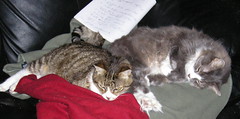
WOLFGANG 1988-2005


Wolfgang
Originally uploaded by Other Lisa.

I had known Wolfgang since he was a kitten, but he didn’t come to live with me until he was around 7. He belonged to my friend Lisa, who was going off to grad school in Hawaii. The quarantine laws there, and the uncertainty of her living situation, made it impossible for Wolfgang to go with her.

She begged me to take him. I really didn’t want another cat. I was living in a cramped Venice apartment, and I had two cats already. “He doesn’t need a lot of room,” Lisa argued. “Besides, all he does is eat and sleep.”

What could I do? I took him in.

Wolfgang was one of the most aggressively friendly cats you will ever meet. He had a bad habit of wanting to sleep on your chest and suck on your ear. This might not have been so bad if he hadn’t been such a fat cat. His nickname was “the Football.” Plus he had tiny little paws. Having him on your lap was sort of like having a really heavy woman in spike heels standing on your thighs.

His affectionate nature sometimes got on my nerves. He had to be on my lap, had to head-butt my laptop screen, had to have my attention when I wasn't always in the mood to give it (especially with those tiny paws indenting my thighs). “Boundaries, Wolfgang,” I would mutter, giving him a little shove. “Just give me a little space, here.”

My rejection never phased him. He loved every person who walked in the room and all other creatures besides. Once he ran out the door of my apartment, into the courtyard, just as one of my neighbors was bringing his Rottweiler down the stairs from the lobby. Wolfgang immediately ran up to the Rottweiler and started head-butting it. On the head. The poor dog was mightily confused. She kept sniffing at Wolfgang, trying to get a good whiff of his butt. You could see what was going on in her little doggie mind: “Smells like cat. Acts like dog. But smells like cat. What to do?!”

The only thing Wolfgang didn’t like was vacuum cleaners. Those were instruments of Satan. They terrified him.

About five years ago, against my better judgment, I took in another cat, a skinny foundling my sister named “Spike,” as an homage to Buffy the Vampire Slayer and also as sort of a joke, as this cat looked about as deadly as a jackrabbit. Shortly after I adopted him, Spike got very sick. The vet never could figure out what it was, some sort of “fever of unknown origin,” possibly feline infectious peritonitis. It seemed likely that Spike would die. I took care of him at home, gave him fluids, force-fed him pills and baby food. Surprisingly, he did get better. As he started to recover, Wolfgang would groom him. It was one of the sweetest things I ever saw. Spike rebounded with a vengeance and proceeded to grow into his name (he weighs about 25 lbs these days). He loved Wolfgang. They frequently groomed each other and curled up on the bed together.

Even Murphy, the queen cat, grew to tolerate Wolfgang as they both got older. Unlike Wolfgang, Murphy has perfected the art of the boneless sprawl and somehow can always find a way to fit onto my lap comfortably. Wolfgang’s traditional position was next to me on the couch, head and front paws on my thigh. Sometimes he and Murphy would use each other as pillows. Murphy, who does not particularly care for other felines, didn’t seem to mind.

As Wolfgang aged, he became frail, no longer the plush football I could roughhouse with. His decline was slow and almost unnoticeable. The 4th cat of my quartet, Mags, was taking up most of my attention with her chronic illness (which was a lot more dramatic, involving as it does lots of barfing and diarrhea). I realized though that Wolfgang didn’t look right. I took him into the vet. His kidneys were starting to fail, and his teeth were in bad shape. I’d need to hydrate him regularly with subcutaneous fluids. That wasn’t a problem for me; I’d done it plenty of times with other sick cats.

The fluids worked. His kidney function went back to normal. I’d have to continue hydrating him, but that wasn’t a big deal. He perked up considerably and put back on some weight.

Then one morning, I heard a thumping noise. It was Wolfgang. He couldn’t put any weight on his hind legs. It didn’t seem to bother him all that much. I however was freaked. I called a house-call vet I’d spoken to before, wondering if he was about to die. Probably not, the vet assured me. That kind of thing isn’t normally connected to kidney failure. I took him into my vet. The disks in his back had collapsed. There was some congestion in his lungs as well. At over 17 years old, his body was simply wearing out.

Predinsone might help him regain some mobility, the vet advised. I tried it. Surprisingly, after a few days, it did. Wolfgang could walk, wobbily, it’s true, seeming to tiptoe on his little paws.

We went on like this for nearly two months, I think. The last couple of weeks, Wolfgang grew weaker. He ate less and less. He still wanted to sit with me on the couch, and by scrambling onto the ottoman, he could get most of the way there without my help.

In the middle of the week, he stopped eating completely. I couldn’t tempt him with anything. I also couldn’t force-feed him. He could clamp his jaw shut with amazing strength, and it was hard enough to get his meds down him. And I thought, what would be the point? He was over 17 years old, and he was getting ready to go.

In spite of this, I felt horribly guilty at times. I should have taken better care of him. I should have gotten his teeth cleaned. I should have loved him more.

By Thursday I was seriously debating what to do. He didn’t seem to be in any pain, but he was increasingly weak and out of it. He would stare off at nothing. He seemed confused, and at times he looked sad. I thought maybe he could die on his own. But how could I be sure that he wasn’t in pain? What if he was sad? I called the house call vet I’d spoken with before, a woman whose compassion and caring over the phone had helped me with this debate earlier. But she was still in New Orleans, volunteering to help animals in the wake of Katrina. I got the name of another vet but didn’t call her. I just couldn’t bring myself to talk to a stranger. I went home.

Wolfgang spent the evening with me on the couch. When it was time for me to sleep, I made a bed for him so he could sleep with me, and if he was incontinent, it wouldn’t make too much of a mess. Some time in the night, he crawled off of that and came to snuggle against my back.

The next morning I decided that it was time to call the vet. There must be something about female house-call vets, because this woman was also compassionate and kind. Her earliest appointment was 4 PM the next day, Saturday. She gave me the number for an animal mortuary service as well, run by a man named Richard, who would come afterwards. Richard explained their services to me. My pet would be individually cremated. His ashes would be returned in a lovely wooden box, and I’d receive a clay impression of his right paw-print and a certificate with the pet’s name and any message I would like. There was something absurd about the whole thing, I thought, but I still cried my eyes out and only barely got through the conversation.

I left work early so I could spend time with Wolfgang. When I got home, he’d somehow gotten himself from the bed I’d made him in the living room the short distance to the front door entry. He often liked to sit by the door, in front of the security screen, maybe because the breeze is nice there. His head rested on a pillow I’d left by the door.

When I came in, he looked up, more alert, happier, it seemed to me, than he’d been yesterday. I talked to him and petted him and scratched behind his ears, and he responded under my hand, nuzzling my palm, nose still cold and a little damp.

I spent the evening with him on the couch. At times he seemed to drift away, barely aware, no longer in control of his limbs. But then, for the longest time, as I scratched and petted him, he responded and nuzzled, arched his back a little, straightened his tail. And started to purr.

He hadn’t been quite able to purr for several weeks, even when he was still pretty mobile and active. It seemed to take too much effort, perhaps because of the lung congestion he had. I wondered now if this was some kind of end of life reflex. I’d heard that before, that cats sometimes purr when they are hurt or dying.

Of course there’s no way to know. But he purred as he exhaled, his breathing even and easy as I scratched his head, and he rested his head in my palm, nuzzling me now and again. We stayed that way for an hour. The pupils in his eyes were huge. What did he see, I wondered? As I scratched and massaged behind his ears, his eyes would close, the way cats do when they are content and basking in your attention.

You project all kinds of things onto your pets, I know. Interpret emotions and feelings that aren’t equivalent to ours. But his face was so relaxed. He seemed so peaceful. He seemed to smile. Cats do smile, you know. Don’t let anyone tell you that they don’t.

“Thank you,” I told him. “Thank you. Thank you for showing me this.”

I made up his bed for him so he could sleep on my bed and not be alone, and I went to sleep.

Sometime around 6 AM I woke up. I knew right away that he was gone. I rested my hand on him. He was still warm.

We do these things for ourselves, I know. Cats aren’t people. I don’t think of my cats as my children. They are cats. Weird little fuzzy companions who join us in our lives for a while and then pass on. Today, after Richard from the Pet Mortuary has come and gone, nothing seems so clear as it did to me last night. Maybe I waited too long. Maybe he was in pain. Maybe there was nothing in his eyes but the emptiness of a life-force that was dwindling away. I don’t know.

I do know one thing. If I didn’t love Wolfgang enough, it didn’t matter to Wolfgang. Wolfgang had more than enough love for me, for anyone who walked in the door of my house, for everyone and everything.

Except vacuum cleaners.

Rule of the Mob

Horrific, shocking story in today's UK Guardian:
One of China's leading democracy activists has been beaten, possibly to death, in front of a Guardian journalist. Lu Banglie was last seen lying unconscious on the side of the road on Saturday night after an assault by a mob which had joined forces with police to stop a car containing him, the Guardian's Shanghai correspondent, Benjamin Joffe-Walt, and two other people.

They were on their way to Taishi, a village in the southern province of Guangdong which has become the latest flashpoint in a growing wave of rural unrest that is proving the greatest threat to the rule of the Communist party since the Tiananmen Square protests in 1989.

Mr Lu, one of a new breed of peasant leaders elected without the support of the party, had been in the area on the outskirts of Guangzhou city since August, encouraging residents to vote out officials accused of corruption...

...In Saturday's attack, Joffe-Walt said the car was stopped on a road outside Taishi by a group of about five police, five soldiers and as many as 50 people in plain clothes. The uniformed men soon left and then the mob set upon Mr Lu, dragging him out of the car and kicking him unconscious. They continued the assault for several minutes after he lost consciousness. "I was convinced he was dead and thought they were going to do the same to us," said Joffe-Walt. But he, his assistant and their driver escaped with being roughed up.
Human rights activists in China were shocked by the story, saying that this level of violence is unprecendented. The most telling statement comes from Ho Wenzhou, of the Empowerment and Rights Institute:
"This is an attack not just on Lu but on all people who work for grassroots democracy and human rights in China. It reveals the mafia-isation of local governments."
To me, "mafia-isation" perfectly describes what has gone on as ideology and totalitarianism have loosened their grip on today's China. We should all be grateful that for many Chinese people, the quality of life has improved and the range of personal freedom greatly expanded. I also believe that the central government has made some positive steps in in their struggle to establish a more coherent set of rules and regulations by which businesses and government agencies should function, particularly in areas such as environmental regulation. But they seem to lack the ability to enforce these good intentions on a local level. And this recent media crackdown does Beijing no favors. A more independent media at least could provide some feedback on what is really going on, in those places where the Emperor is far away.

What seems to be emerging in today's China is not the Rule Of Law, it's the Rule of the Mob.

Thanks to Zhuanjia for the tip.

Saturday, October 08, 2005

Thursday, October 06, 2005

Gobi Desert Dreams

The LA Times has a strange, poignant story from one of my favorite China reporters, Ching-Ching Ni, about how societal change occurs in fits and starts and sometimes, staggering leaps:
YELLOW SHEEP RIVER, China — This village on the edge of the Gobi desert entered the 21st century much as it had the previous one, with yellow sand blanketing the mountains and poor farmers sharing their mud huts with cows, donkeys and pigs.

No homes had running water. No shops sold clothes, just bundles of fabric to be sewn into shirts and pants. Donkey carts plied the dusty main street, rarely troubled by the rumble of a motor.

No one in this forgotten section of northwestern China seemed to realize that the nation's east coast was booming or that dot-coms were changing the world. But then, out of the blue, came an idea — and a multimillionaire — that promised to bring prosperity here.

High-tech entrepreneur Sayling Wen heard about the village and decided that by harnessing the power of computers, he could beam its 30,000 inhabitants into the Information Age economy.

Never mind that the Taiwanese tycoon had never laid eyes on the place. He would turn Yellow Sheep River into China's first "Internet village."
Inspired by a former classmate, Kenny Lin, who told him about Yellow Sheep Village, and perhaps by his own poverty-stricken childhood, Wen decided he would build a five star hotel and a conference center in this Gobi Desert outpost.
But the real giddiness set in when Wen made his first visit in April 2002 to break ground for the hotel. As many as 10,000 farmers came to meet the miracle maker. Some walked more than 10 miles, others rode horses. The nimble climbed trees for a better view. The sound of drums and gongs filled the early spring air.

Wearing a dark suit and tie, the round-faced and solidly built Wen showed visiting Chinese officials a model of the hotel. He cut ribbons and helped shovel dirt. He posed for the cameras.

"I'm investing in Yellow Sheep River and building a five-star hotel and Internet village because I want to turn Yellow Sheep River into a knowledge-based economy fit for the 21st century," Wen told the crowd. "My hope is that you no longer have to leave home to find work. As long as you come here to the Internet village, you can create wealth, you can change your life and you can preserve your traditional culture."
. As usual, Ni tells this story with an eloquence that defies summarizing. Go read the whole thing. If you can't get to the article behind the Great Firewall, email me, and I'll send it to you.

Sunday, October 02, 2005

Torture? What Torture?

From Reuters:
The White House on Friday threatened to veto a $440.2 billion defense spending bill in the Senate because it wasn't enough money for the Pentagon and also warned lawmakers not to add any amendments to regulate the treatment of detainees or set up a commission to probe abuse.

Last summer, Republican Sens. John McCain of Arizona and John Warner of Virginia and others sought legislation banning cruel and degrading treatment of prisoners.
After all, why should the White House care what a former POW who experienced torture first-hand thinks? Private Lynndie England's been convicted; that takes care of the problem, right?

What does this Administration have to fear, anyway?

Friday, September 30, 2005

Saving Shangri-La

The invaluable Three Gorges Probe, a news service/website originally reporting on the infamous Three Gorges Dam, has for some time expanded its focus to deal with other hydroelectric projects in China and their environmental and cultural consequences. They continue their excellent coverage with this translation of a CCTV documentary about local people in one of China's most beautiful natural attractions, Tiger Leaping Gorge, whose ancestral lands may be flooded by future dam building projects on the upper Yangtze (Jinsha) River. Here's an excerpt:
1. Who is going to break the villagers' rice bowl?

Legend has it that Shangri-La is heaven on earth, a mythical, exotic, dreamy landscape. In Lost Horizon, American novelist James Hilton depicted Shangri-La as a wonderland in which people live in harmony with nature and each other.

Late last century, people found a real Shangri-La in the Hengduan mountain range, where the Jinsha [upper Yangtze] flows in southwest China. Jinjiang town in Diqing Zang autonomous prefecture, Yunnan province, is the real Shangri-La in many people's minds, where a multitude of minority groups, including Yi, Tibetan, Bai, Naxi, Lisu and Miao, have lived together for generations in peace and harmony.

Recently, however, local people have begun to feel uneasy, upset by a piece of news. They have heard that a big dam is to be built on the Jinsha River so that water can be diverted to central Yunnan province and, in particular, to the provincial capital of Kunming. Roughly 100,000 people will have to move if the project goes ahead.

Engineers are conducting surveys of the proposed dam site, and red marks [indicating the future water level of the dam's reservoir] have already been painted on some walls, despite the fact that the central government has not yet approved the project. Although the scheme is still at the feasibility-study stage, everybody here is extremely worried, particularly because they have been given so little information about the project.

Chezhou village, part of Jinjiang town, is one of the places that will be affected if the dam is built. Villagers set off together for the village office, hoping to learn more from village leaders. One of the villagers is 67-year-old Ding Changxiu. Her children are grown now, and have left the village for jobs in the county seat. It would be better for her and her husband to move there to live with their children, but Ding would rather stay put because she loves her native place so much.

Villager: We know nothing about the project. I'm wondering if the village leaders know anything about it. We old peasants deserve to know something about it, don't you think?

Ding Changxiu: I feel as if there's a stone weighing down my heart. I was told we'd have to leave tomorrow! The whole village is on tenterhooks. I just met an elderly woman in the village who swore she'd rather die at home than be driven away.

Village leader: Calm down, folks! It's true that the province has proposed building a dam here to move water to central Yunnan. But whether we'll have to move is not clear, because the project hasn't been formally approved, and the experts haven't even finished the feasibility study yet.

The village leader's comments did nothing to ease the villagers' anxiety. The local people love dropping in on one another to chat about all manner of things, but now there is only one topic of conversation: the dam.

Villager: We ordinary people know nothing about it. And we have absolutely no way of leaving even if we are forced to move.

Villager: There are four people in my family. Now we have grain that's surplus to our own needs that we can sell for cash, and I have chickens and pigs that I could kill right now to offer you. We lead a comfortable life, but the good life will be gone forever if we have to move.

Villager: We old people don't care about ourselves any more; we're too old now. But we do care very much about our children, and the younger generations are in for a very hard time if we're moved far away.

This reluctance to move stems not only from local people's deep attachment to the ancestral land on which they have lived for centuries, but also from their awareness of the special nature of the magnificent place they call home. They live at the famous "first bend of the Yangtze" in the Tiger Leaping Gorge area, and they know the value of this spot.

The section of the Jinsha River in front of their houses, together with two other great rivers Ð the Lancang (Mekong) and Nu (Salween) Ð form the Three Parallel Rivers National Park, which UNESCO has designated a world heritage site. Local people are not only tremendously proud of that, but also genuinely seek to safeguard the environment of their native area.

In March of this year, a work team was sent to the village from Xianggelila county to meet with village leaders. The villagers guessed that the work team's arrival had something to do with dam-building, but they had been given no real information, so rumours swirled.

Villager: Somebody told me they'll be paying compensation of 10,000 yuan [US$1,200] per mu [one-fifteenth of a hectare or one-sixth of an acre] of farmland flooded by the dam. The person who told me that said he got the information in a phone call from one of his friends in the county seat. I'm not really sure about it, but in any case I'll never move. You see, we're treated like nothing!

Ding Changxiu: Oh dear! Only 10,000 yuan for a mu of land! We can feed ourselves for 10,000 generations by farming our land. Can 10,000 yuan provide the younger generations with enough to eat and wear?

Villager: It's easier to destroy than to build!

Ding Changxiu: How many days can 10,000 yuan keep us fed? How many years can 10,000 yuan keep us fed?
It's a measure of the complexity of contemporary China and, I suspect, the factionalization of the Central and Provincial governments, that amidst increasing media and internet censorship, a documentary of this sort can be produced and shown on national television. One hopes that this kind of publicity and the increasing grassroots activism of China's environmentalists and the local people who stand to lose the most from these ill thought-out projects will be enough to preserve these national treasures for future generations. Right now, however, the decision could go either way. Past reports from Three Gorges Probe have detailed the pressure on local governments to approve such projects as spurs to development and the role of corruption and kickbacks in the decision-making process. It's still an open question if the government regulations that exist on paper to properly review and prohibit these projects have sufficient teeth to fight this powerful nexis of money and greed.

On the other hand, I've often thought that China's environmental movement contains within it the seeds of greater dem0cracy for China. As unmoored as China has become from much of its traditional culture, the ideas of balance and unity contained in Daoism, that man is a part of nature rather than its detached overlord, still has some potency.

You can find a series of photos of Tiger Leaping Gorge here...

Wednesday, September 28, 2005

Criminally Stupid

This is a wretchedly awful move on the part of the Chinese government, if they do in fact go ahead with plans to reopen legal trade in tiger parts:
Tiger organs, teeth, bones and penises fetch high prices on the black market, where they are used in traditional Chinese medicines to treat ailments like rheumatism. In other parts of Asia, the bones are considered an aphrodisiac.

China banned domestic trade in all tigers and tiger parts in 1993, but is considering re-opening the business based on farm-bred, captive animals.

But that would send a signal that it is acceptable to buy tiger parts which would threaten wild tiger populations, experts in the wildlife trade said.

"We're afraid that poachers living near the world's last populations of tigers may kill them to supply illegal markets that are likely to develop alongside any new legal ones," Susan Lieberman, head of WWF's Global Species Programme, said in a statement.

"This could be the final act that drives the tiger towards extinction."
I can't think of any positive spin, any possible excuse for this. What in the world is motivating the government? Surely tiger farmers and traders in animal parts aren't that powerful a lobby. I can only take cultural relativism so far. Some things are just wrong.

If anyone has any suggestions on how to take action against this disgusting, irresponsible decision, please let me know...

Friday, September 23, 2005

Spike Kills A Mouse


Spike Kills A Mouse
Originally uploaded by Other Lisa.

I thought it was time to return to Friday Cat Blogging. Can you tell that it's a catnip mouse?!